News
Claude API pricing after Sonnet 5.5 and Opus 5.5: cost per task
Anthropic released Claude Opus 5.5 and Sonnet 5.5 in late September 2026. What changed, what each Claude model costs per task, and which one to pick.
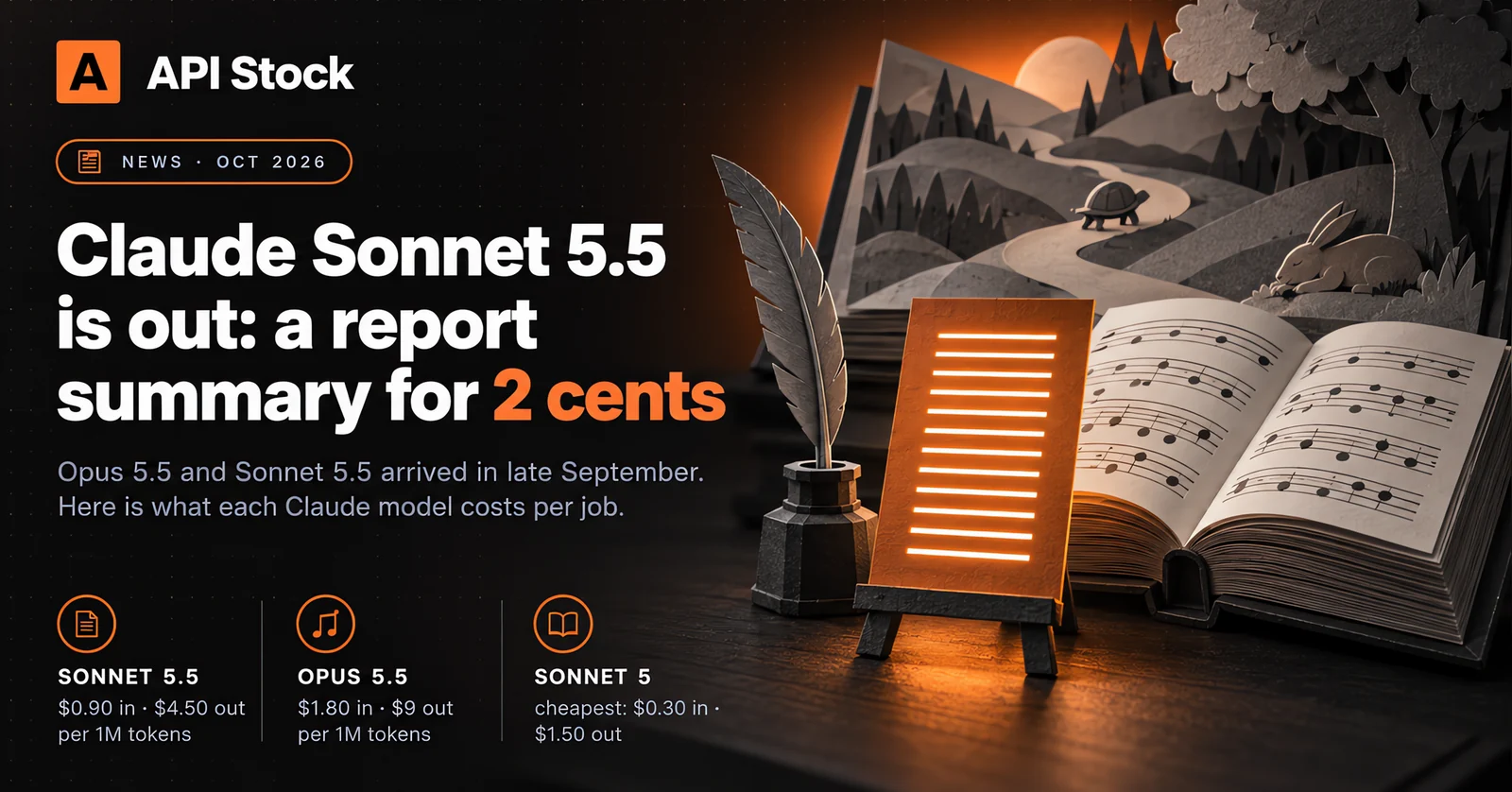
Anthropic released Claude Opus 5.5 on 22 September 2026 and Claude Sonnet 5.5 on 28 September. Through API Stock, Sonnet 5.5 costs $0.90 per million input tokens and $4.50 per million output tokens, and Opus 5.5 costs $1.80 and $9 — so summarising a 10,000-word report comes to about 2 cents on Sonnet 5.5 and 4 cents on Opus 5.5. The older Claude Sonnet 5 is still the cheapest Claude in the catalog, at $0.30 and $1.50.
What did Anthropic release, and when?
Two models in one week, both replacing a model from the summer:
- Claude Opus 5.5 — 22 September 2026. The first of the new 5.5 family and Anthropic's model for long, difficult work. The announcement cut the price as well: "Input and output tokens are $4 and $20 per million, 20% less than Opus 5."
- Claude Sonnet 5.5 — 28 September 2026. The everyday model. The announcement keeps Sonnet 5's price and calls it "our fastest Sonnet model to date".
- Claude Haiku 5.5 — not out yet. The same page says the small, cheap tier "will join the Claude 5.5 family in the coming weeks". No price has been published.
Anthropic's own list prices, per million tokens, from its pricing page:
| Model | Released | Input | Output | Cache read |
|---|---|---|---|---|
| Claude Opus 5.5 | 22 Sep 2026 | $4 | $20 | $0.20 |
| Claude Opus 5 | 24 Jul 2026 | $5 | $25 | $0.50 |
| Claude Sonnet 5.5 | 28 Sep 2026 | $2 | $10 | $0.20 |
| Claude Sonnet 5 | 30 Jun 2026 | $2 | $10 | $0.20 |
Both new models read up to 1 million tokens in one request and write up to 128,000, and both know the world up to June 2026, according to Anthropic's model overview. The same page now files Sonnet 5, Opus 5 and Fable 5 under "Legacy models (still available)". The release dates of the two older models in the table are the ones recorded in the API Stock catalog.
On API Stock both new models are live: Claude Sonnet 5.5 and Claude Opus 5.5 sit in the catalog next to four other Claude models, on the same key and the same prepaid balance as everything else.
What changed compared with Sonnet 5 and Opus 5?
Less than a new generation, more than a patch. In plain terms:
- They answer faster. Anthropic reports output more than 30% faster than the previous model, for both.
- They use fewer tokens for the same job, which is what the bill is made of. For Sonnet 5.5: "In our testing, it costs up to 30% less per task than its predecessor." For Opus 5.5: "Our tests show that at default settings it will cost 40% less than Opus 5 on typical workloads" — a figure that includes the 20% price cut.
- They think before answering, and on Opus you cannot turn that off. Opus 5.5 "is also no longer available with “thinking” mode switched off". Sonnet 5.5 thinks by default and lets you dial it down. This matters for cost; see the trade-offs below.
- Sonnet got much better at long coding jobs. Anthropic's number: 70.6% on Terminal-Bench 4.0, against 10.3% for Sonnet 5. On GDPval-AA, a test of real office work across 44 occupations, Sonnet 5.5 scores 1844 and Opus 5.5 scores 1846 — two points apart.
That last pair of numbers is the interesting one, and Anthropic explains the gap itself: "Where Opus 5.5 is built for complex work requiring careful judgment, Sonnet 5.5 is strongest at well-scoped everyday tasks, fixing bugs, and creating polished documents, slides, and spreadsheets." Give both a clear brief and you may not see a difference. Give both a vague, week-long problem and you should.
All of these are the vendor's own measurements. They tell you where to look, not what you will get — run ten of your real tasks through both before you move anything important.
How much does the Claude API cost now?
Prices from the live API Stock catalog as of 4 October 2026, USD per million tokens:
| Model | Input | Output | Cache read | Cache write |
|---|---|---|---|---|
| Claude Sonnet 5 | $0.30 | $1.50 | $0.03 | $0.375 |
| Claude Sonnet 5.5 | $0.90 | $4.50 | $0.09 | $1.125 |
| Claude Fable 5 | $1.50 | $7.50 | $0.15 | $1.875 |
| Claude Opus 5.5 | $1.80 | $9.00 | $0.09 | $2.25 |
| Claude Opus 5 | $3.00 | $15.00 | $0.30 | $3.75 |
| Claude Fable 5.1 | $10.00 | $50.00 | $0.25 | $12.50 |
If you have never paid for a language model: you are billed for the text going in (your instructions and documents) and, at a higher rate, for the text coming out. Text is counted in tokens, which are pieces of words. Anthropic puts a million tokens at roughly 555,000 English words on its current models, so 1,000 words is about 1,800 tokens. "Cache read" is the discounted rate for a block of text you send again and again, such as a long set of instructions.
These are API Stock's own prices, separate from Anthropic's list. As of today both 5.5 models, and Sonnet 5, Opus 5 and Fable 5, are listed below Anthropic's price; Fable 5.1 is at it. Three things in this table are easy to miss:
- Opus 5.5 is cheaper than Opus 5 on every line — 40% lower on input, output and cache writes, 70% lower on cache reads. Nothing on price argues for staying on Opus 5.
- Sonnet 5.5 costs three times what Sonnet 5 does here. At Anthropic the two share one price, so upgrading is free; on API Stock it is not. Even if the full 30% token saving shows up, a task costs about twice as much on 5.5.
- Cached text costs the same on Sonnet 5.5 and Opus 5.5: $0.09 per million. For work that re-reads a large context many times, Opus is closer to Sonnet than the headline rates suggest.
The whole lineup, with every other text model, is on the Claude family page and the pricing page.
What does a real task cost?
Per-million rates mean little until you put a job through them. Four jobs, costed at the rates above:
| Job | Sonnet 5 | Sonnet 5.5 | Opus 5.5 | Fable 5.1 |
|---|---|---|---|---|
| Summarise a 10,000-word report into 500 words | $0.007 | $0.020 | $0.041 | $0.225 |
| Write a 1,500-word article from a 300-word brief | $0.004 | $0.013 | $0.025 | $0.140 |
| A support assistant for a month, 5,000 conversations | $6 | $18 | $36 | $200 |
| One long agent session that re-reads a big project | $0.26 | $0.79 | $1.42 | $7.45 |
How the rows are counted: the report is 18,000 tokens in and 900 out; the article is 540 in and 2,700 out; a support conversation is 2,000 tokens in and 400 out, the same workload as in our LLM pricing guide; the agent session reads 2 million tokens, 90% of them from cache, and writes 100,000 (cache writes left out).
Read these as the floor. They count the text you see. The reasoning a model does before it answers is billed as output too, and it is not in these figures — a short, clear task adds little, a hard one can add more than the answer itself.
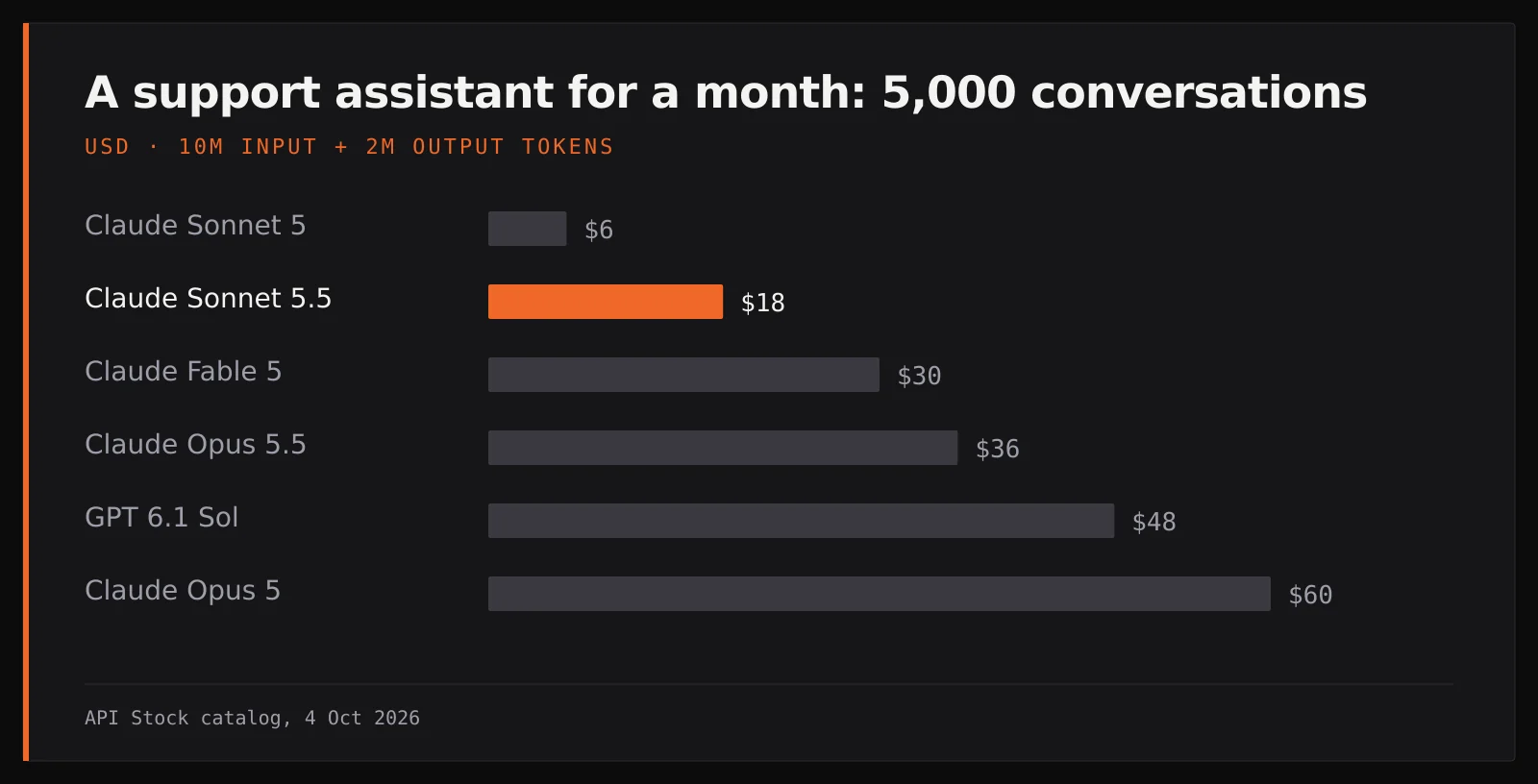
The practical reading: on Sonnet 5.5 a support conversation costs about a third of a cent, a report summary two cents, an article draft just over one. At these prices the model is rarely the expensive part of the job; the hour you spend checking its work is.
Which Claude model should you pick?
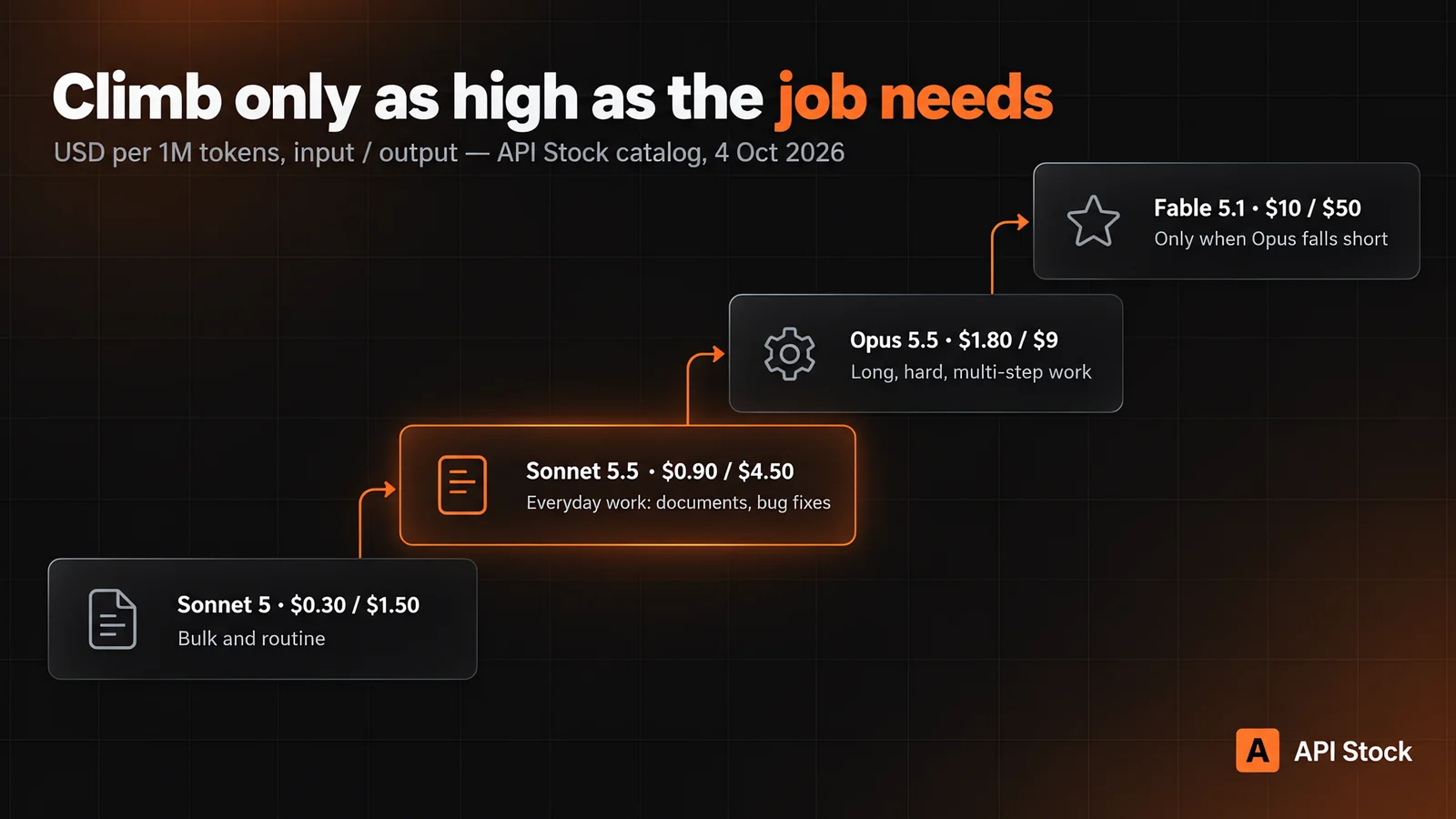
Start low and move up only when the result tells you to.
- Claude Sonnet 5 — bulk and routine. Sorting incoming mail, tagging reviews, short replies from a template, first drafts you will rewrite anyway. At $0.30 and $1.50 it is a third of the price of 5.5. The catch: Anthropic now lists it as legacy, so treat it as a model for today rather than for the next two years.
- Claude Sonnet 5.5 — the default. A report that has to be right, slides and spreadsheets, a bug fix, a customer answer that needs judgment. It is the one to try first if you are new to Claude.
- Claude Opus 5.5 — long and difficult work. A change across a large codebase, research across dozens of documents, a plan with many steps where a mistake in step two ruins step nine. Exactly twice Sonnet 5.5's rate, and still below what Opus 5 costs.
- Claude Fable 5.1 — rarely. Five and a half times the price of Opus 5.5. Anthropic's own advice is to use it "for demanding reasoning and long-horizon agentic work, or when your evals on Claude Opus 5.5 at higher effort still fall short".
- Claude Fable 5 is described in the catalog as tuned for long-form writing and narrative, at $1.50 and $7.50. Worth a side-by-side test against Sonnet 5.5 if your work is prose.
If you send a lot of traffic, do not choose one model — choose a rule. Send everything to Sonnet 5 or 5.5 and pass only the hard cases up to Opus 5.5. With a twofold to sixfold gap between the steps, escalating one request in ten costs far less than running the top model for all of them.
How does Sonnet 5.5 compare with GPT 6.1 Sol?
OpenAI released GPT-6.1 Sol on 29 September, one day after Sonnet 5.5, at the same list price: $2 in and $10 out per million tokens, a fifth of what its top model GPT-6 Astra costs, as The Next Web reported. The two vendors now have their workhorse models at one identical price.
On API Stock they are not identical. GPT 6.1 Sol is $2.40 in and $12 out as of 4 October — above OpenAI's own list price, where the Claude models are below Anthropic's. The support month from the table above costs $18 on Sonnet 5.5 and $48 on GPT 6.1 Sol.
Price says nothing about which one writes the better answer to your question. Both run on the same key, so the honest test is cheap: send the same twenty prompts to each and read the results. The side-by-side comparison puts their rates next to each other.
How do you try it?
Without code: open the Sonnet 5.5 page, paste your prompt into the playground and read the answer. It is billed from your balance like any other request.
With code: Claude models answer on the OpenAI-compatible endpoint, so any tool that can talk to OpenAI can talk to them by changing two settings — the address and the model name.
curl -N -X POST https://api.api-stock.com/api/v1/chat/completions \-H "Authorization: Bearer $API_STOCK_KEY" \-H "Content-Type: application/json" \-d '{"model": "claude-sonnet-5-5","max_tokens": 2000,"stream": true,"messages": [{ "role": "system", "content": "You write for busy managers. Plain words, no preamble." },{ "role": "user", "content": "Summarise the report below in five bullet points, then list the three decisions it asks for.\n\n<paste the report here>" }]}'
Three things to know before the first run:
- Leave room in
max_tokens. Thinking counts toward it. A limit of 300 can be spent before the visible answer starts. - Stream long answers. A request that sits silent for about 100 seconds is cut off; with
streamon, text arrives as it is written. - Leave out
temperatureandtop_pon Sonnet 5.5. Anthropic's model page says a non-default value is rejected.
To switch to Opus, change the model to claude-opus-5-5. The request fields and the full model list are in the
Chat Completions reference; the
production checklist covers keys, retries and balance alerts.
What are the limits and trade-offs?
- Thinking is billed and partly out of your hands. Anthropic's documentation is plain about it: "the tokens Claude spends reasoning are billed as output tokens, even when the thinking text isn't returned to you". On Opus 5.5 and Fable 5.1 it is always on. Watch the token counts of your first real requests, not the estimate.
- No batch discount, no fast mode. Anthropic sells both directly: half price for jobs that can wait, and a faster Opus at a premium. The API Stock catalog has four rates per model and neither of those. If your workload is a nightly batch of millions of documents, price it against Anthropic's batch tier before deciding.
- The benchmarks are the vendor's. Both models are days old, and independent testing has only started.
- Legacy models can go away. Sonnet 5 is the cheapest Claude here and also on Anthropic's legacy list. Keep the model name in a setting, not scattered through your code.
- Some security work is handed down. Anthropic says of Sonnet 5.5 that "higher-risk cybersecurity tasks will visibly fall back to Sonnet 5", while ordinary bug fixing is unaffected.
- Prices move. Every figure here is from 4 October 2026; the pricing page is always current.
FAQ
How much does the Claude API cost?
Through API Stock, as of 4 October 2026: Claude Sonnet 5 is $0.30 per million input tokens and $1.50 per million output tokens, Sonnet 5.5 is $0.90 and $4.50, Opus 5.5 is $1.80 and $9, and Fable 5.1 is $10 and $50. Anthropic's own list price is $2 and $10 for Sonnet 5.5 and $4 and $20 for Opus 5.5.
When were Claude Sonnet 5.5 and Opus 5.5 released?
Opus 5.5 on 22 September 2026 and Sonnet 5.5 on 28 September 2026. Anthropic says Haiku 5.5, the small low-cost model, will follow "in the coming weeks".
Is Claude Sonnet 5.5 more expensive than Sonnet 5?
At Anthropic, no: both list at $2 and $10 per million tokens. On API Stock, yes: Sonnet 5.5 is $0.90 and $4.50 against $0.30 and $1.50 for Sonnet 5, three times the rate. Sonnet 5.5 uses fewer tokens per task, which narrows the gap but does not close it.
Should I use Sonnet 5.5 or Opus 5.5?
Sonnet 5.5 for clearly defined everyday work: documents, summaries, bug fixes, customer answers. Opus 5.5, at twice the rate, for long multi-step work where judgment matters. On Anthropic's office-work benchmark the two are two points apart, so start with Sonnet and move up only for the tasks it gets wrong.
What does it cost to summarise a document with Claude?
A 10,000-word report summarised into 500 words costs about $0.007 on Sonnet 5, $0.02 on Sonnet 5.5 and $0.04 on Opus 5.5, before any thinking tokens. That is 18,000 tokens in and 900 out.
Do I need an Anthropic account to use Claude through API Stock?
No. One API Stock key and one prepaid balance cover every Claude model in the catalog, along with GPT, Gemini, DeepSeek and the image, video and music models. Claude answers on the OpenAI-compatible Chat Completions endpoint.
- claude
- llm
- pricing
- news
Try it with your own key
Every model mentioned here is live in the API Stock catalog — one API key, one prepaid balance, automatic fallback between providers.
Read next
 NewsSora 2 API is shut down: the alternatives and what they costOpenAI retired the Sora 2 API on 24 September 2026. Which video model replaces it for each job, what an 8-second clip with sound costs now, and how to switch.·7 min read
 PricingSeedance 2.5 API: release date, pricing and cost per clipSeedance 2.5 launched on 31 July 2026. What it costs per second at 480p, 720p and 1080p, what changed since 2.0, and when a cheaper Seedance does the job.·8 min read
 TutorialSuno API guide: all 31 actions, modes and pricesA practical map of all 31 Suno API actions: create songs, edit tracks, extract stems and data, choose simple or custom mode, and price each step.·7 min read