Comparison
GPT-6.1 Sol vs Claude Sonnet 5.5: benchmarks and cost
Compare GPT-6.1 Sol and Claude Sonnet 5.5 using Artificial Analysis benchmarks, Agent Arena intervals, API protocols and a fixed token budget.
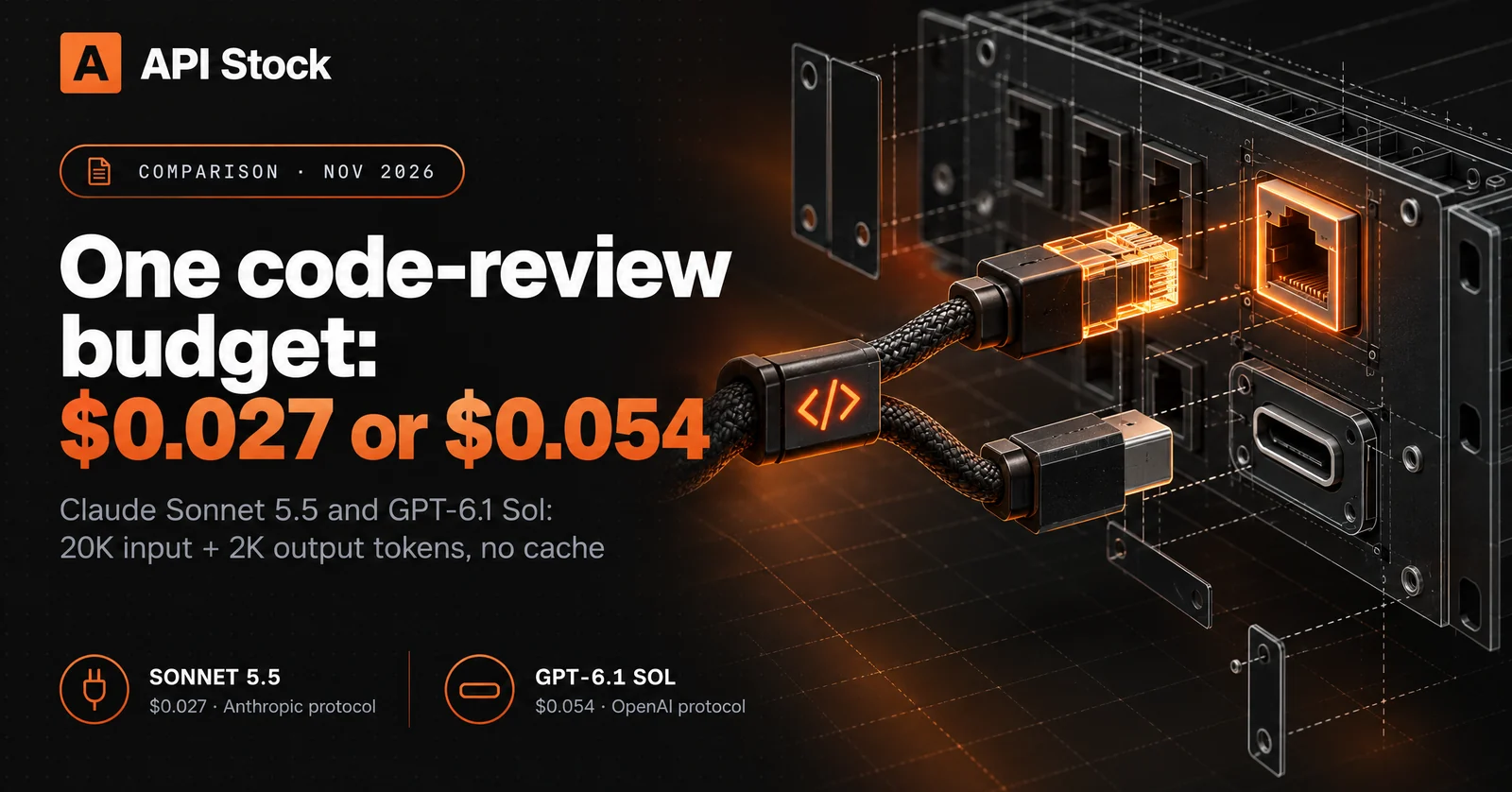
Claude Sonnet 5.5 has the lower token tariff on API Stock: a workload with 20,000 uncached input tokens and 2,000 output tokens calculates to $0.027, versus $0.054 for GPT-6.1 Sol. Your application's protocol matters too: Sonnet uses Anthropic Messages here, while Sol uses OpenAI Chat Completions. Compare a real task before treating the cheaper token rate as the cheaper finished job.
Updated 5 November 2026: added Artificial Analysis and Agent Arena results, test conditions, intervals and a dated evidence snapshot.
Why compare these two models?
Anthropic released Sonnet 5.5 on 28 September 2026, positioning it for scoped coding and everyday professional work. OpenAI's 29 September changelog introduced GPT-6.1 Sol for complex coding and professional tasks. Both are available in today's API Stock catalog.
Published results place Sonnet higher on Terminal-Bench 4.0 while the aggregate index is tied. Below we separate external capability evaluations from API Stock tariffs, then show how to check a task in your own repository.
What do the published benchmarks show?
Artificial Analysis provides the results below, retrieved 5 November 2026. The configurations are GPT-6.1 Sol: Max and Claude Sonnet 5.5: Max, Default Fallback. The fallback label belongs to the evaluated configuration; do not assume our API reproduces it.
| Metric and unit | GPT-6.1 Sol | Claude Sonnet 5.5 |
|---|---|---|
| Intelligence Index v5.0.1 · points | 55 | 55 |
| Terminal-Bench 4.0 · % | 56 | 64 |
| FrontierCode 2.0 · % | 41 | 42 |
| AA-Briefcase v1.1 · Elo | 1555 | 1813 |
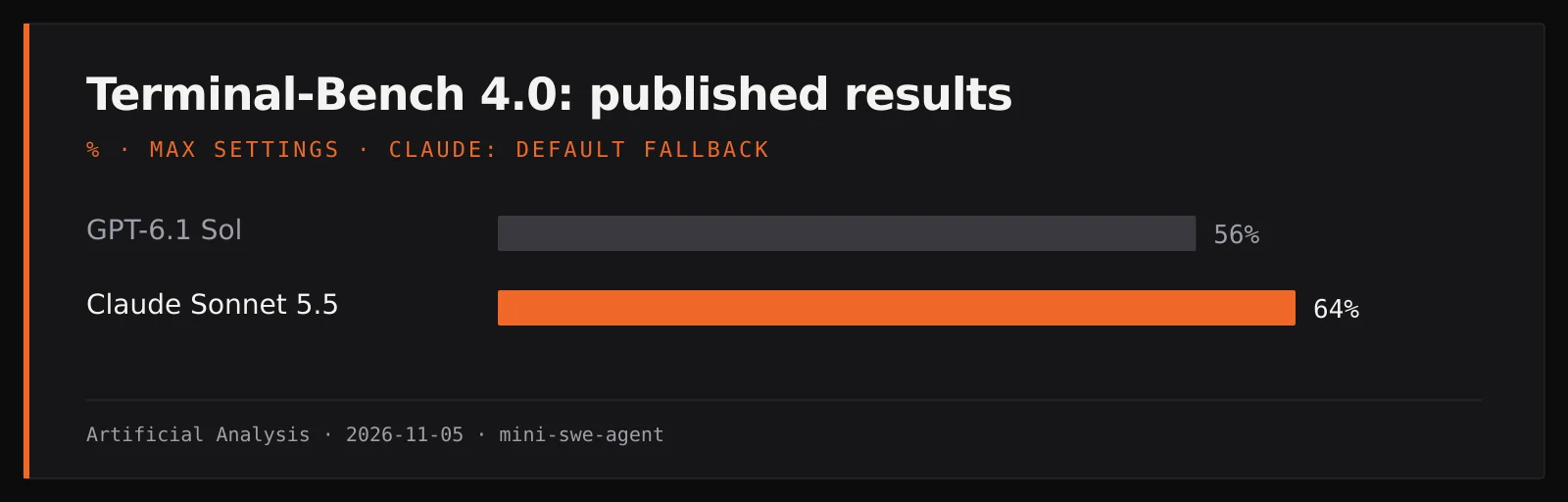
Terminal-Bench 4.0 runs 66 terminal tasks through mini-swe-agent, averaging pass@1 over three repeats; all verifier tests must pass. FrontierCode 2.0 uses 132 tasks, three attempts and Stirrup, with held-out tests and an LLM-judged rubric. Their percentages describe different tasks and scoring rules.
Intelligence Index v5.0.1 combines nine evaluations: index points are not percentage accuracy. Max is each model's maximum effort setting, not an equal compute budget. We preserve the source's displayed precision. The comparison page does not supply row-level confidence intervals or exact run timestamps; the date above is our retrieval date.
AA-Briefcase v1.1 evaluates 91 tasks producing work files; its combined Elo includes rubric, analytical quality and presentation. It is not a percentage of successful code fixes.
The aggregate index is tied, while Sonnet scores higher on Terminal-Bench and AA-Briefcase. FrontierCode differs by one rounded percentage point; without intervals, that small gap does not establish a reliable advantage. Validate code-review findings against your own repository.
What does Agent Arena add?
The Agent Arena leaderboard dated 4 November 2026 offers a separate view of real sessions:
| Model | Net Improvement, percentage points · estimate ± 95% CI half-width | Sessions |
|---|---|---|
| GPT-6.1 Sol (Max) | 12.51 ± 1.11 | 30,285 |
| Claude Sonnet 5.5 (Max) | 15.42 ± 2.78 | 8,596 |
Arena's method estimates model-selection effects from session signals using randomized components. Net Improvement is a treatment-effect estimate, not a task-completion rate. It cannot be combined with Terminal-Bench percentages.
Sol and Sonnet have overlapping intervals; their row order does not establish a dependable advantage on your workload. These are external evaluations, not measurements of API Stock or its routing. The dated evidence snapshot preserves the numbers and conditions.
Which API does each model use on API Stock?
The live catalog, checked 5 November 2026, lists these protocols:
| Choice | GPT-6.1 Sol | Claude Sonnet 5.5 |
|---|---|---|
| Exact model ID | gpt-6.1-sol | claude-sonnet-5-5 |
| Listed protocol | OpenAI | Anthropic |
| Endpoint | POST /api/v1/chat/completions | POST /api/v1/messages |
| Basic request | model and messages | model, messages and required max_tokens |
| Result | Chat completion response | Anthropic message response |
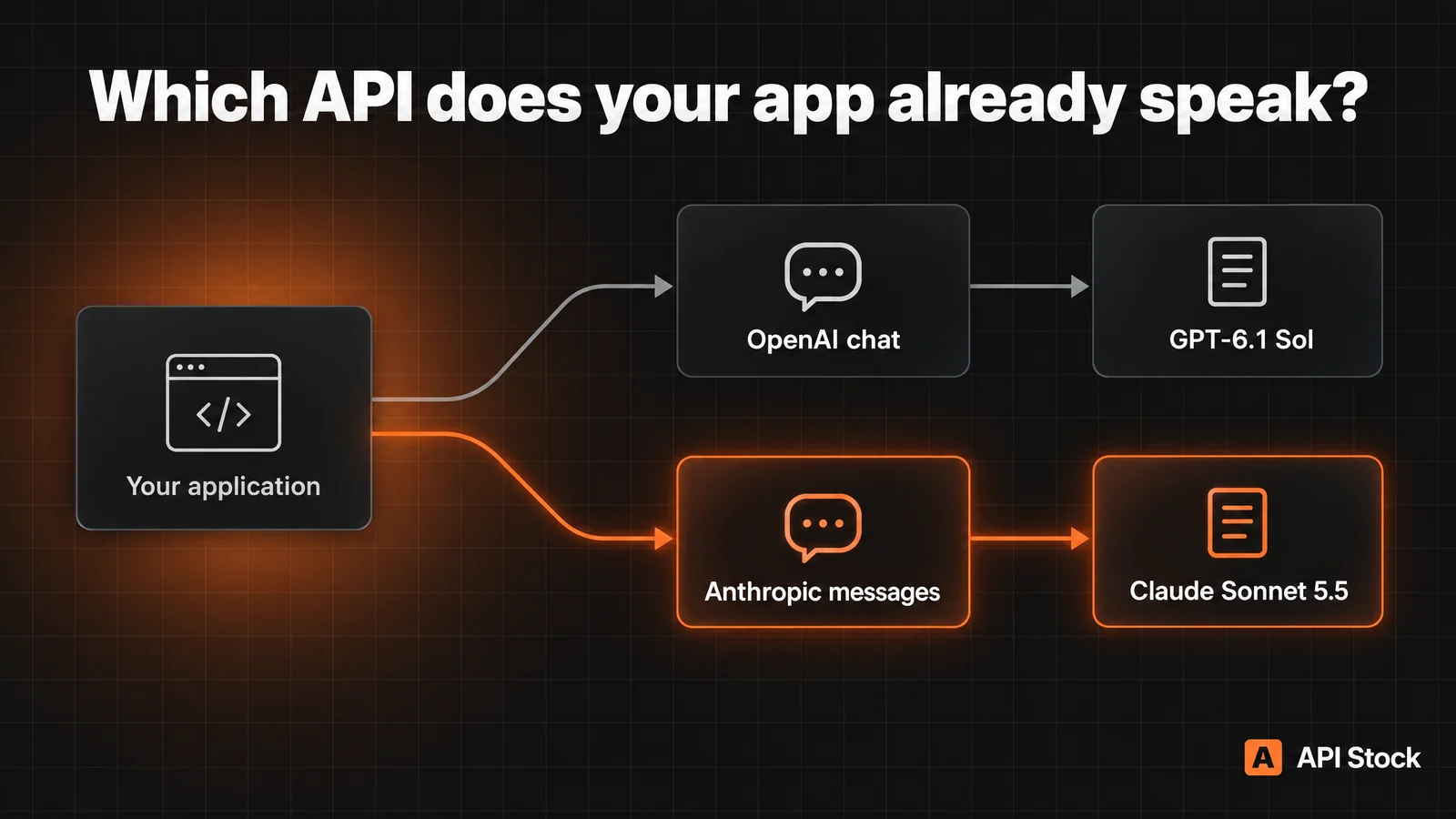
Changing only the model name in one endpoint is insufficient. An app already parsing Anthropic content blocks has less integration work to try Sonnet 5.5; an OpenAI chat client can start with GPT-6.1 Sol. Check the OpenAI protocol guide and Anthropic protocol guide before switching request or response handling.
OpenAI's native model documentation also describes Responses API tools. Those native features do not establish that the Chat Completions endpoint here exposes the same hosted tools, agent runtime or subscription benefits. A coding-agent harness and a chat-model API are separate integrations.
What does the same token workload cost?
Prices below are API Stock USD per one million tokens as of 5 November 2026, from the live catalog. They are separate from either developer's direct API tariff.
| Token category | Sonnet 5.5 | GPT-6.1 Sol, standard context |
|---|---|---|
| Uncached input | $0.90 | $1.80 |
| Output | $4.50 | $9.00 |
| Cache read | $0.09 | $0.18 |
| Cache write | $1.125 | $2.25 |
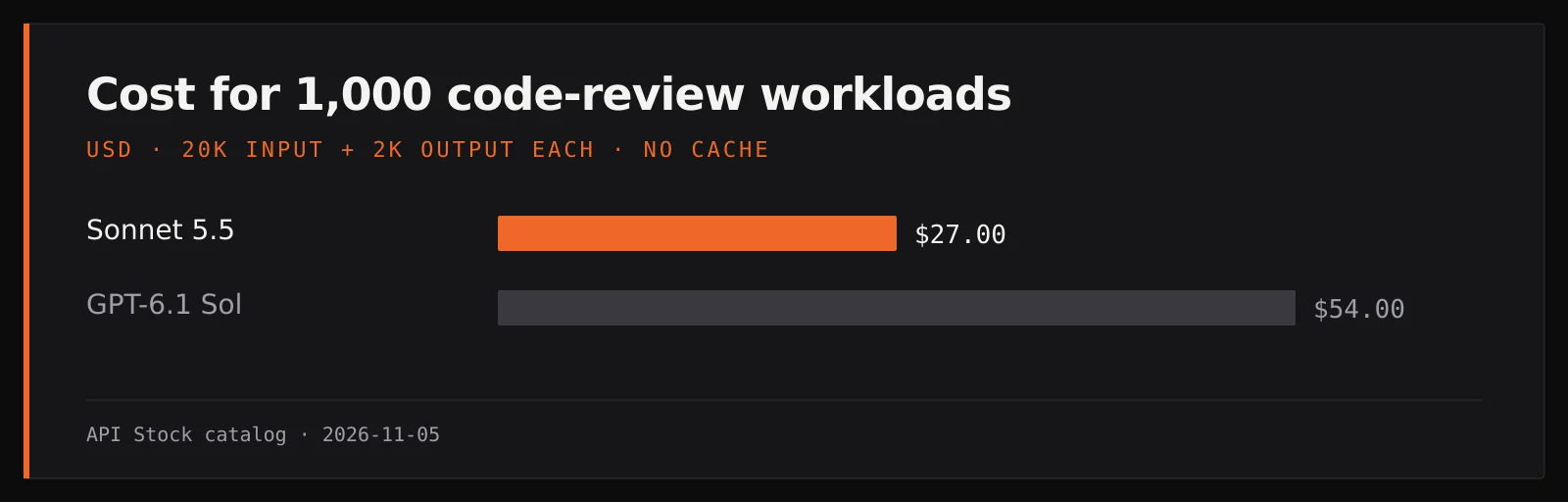
For an assumed, uncached workload of 20,000 input and 2,000 billed output tokens:
- Sonnet:
20,000 / 1,000,000 × 0.90 + 2,000 / 1,000,000 × 4.50 = $0.027. - Sol:
20,000 / 1,000,000 × 1.80 + 2,000 / 1,000,000 × 9.00 = $0.054.
A thousand such workloads calculate to $27 and $54, respectively. This assumes equal billed token counts; it is not a prediction that both models use the same number of tokens. Cache hits, retries, a longer conversation and additional billed reasoning can change the total. Use the response's usage record and the account's charge rather than estimating tokens from visible answer length.
What happens above 272,000 input tokens?
The current catalog gives Sol a separate tariff when input exceeds 272,000 tokens: $3.60 per million input and $15.75 per million output. A hypothetical 300,000-input, 10,000-output request therefore calculates to $1.2375, without cache. Applying the standard rate would understate its cost. Sonnet has no separate long-context tariff listed in this snapshot; the same assumed counts calculate to $0.315.
A pricing threshold is not a guarantee that any payload up to the developer's advertised context limit is accepted. Verify the service's current request limits and your complete prompt, including conversation history, before sending a large document. The dated tariff snapshot preserves both rate sets.
How can you compare a real code-review task?
Take the same diff and the same relevant files. Ask both models:
Review this diff for defects introduced by the change. Return at most three findings. For each, give the file, the affected behavior, evidence from the supplied code and a minimal reproduction. If the evidence is insufficient, state what is missing. Keep unrelated refactors out of the response.
Judge findings by whether the defect can be reproduced and whether the review stays within scope. Record all paid attempts, manual review time and accepted findings. A polished explanation alone is insufficient evidence of a useful review. Stop a trial when repeated answers invent code or recommend changes outside the brief; inspect the input before buying more attempts.
These minimal requests illustrate the two contracts. They were checked against the public schema, not executed as paid model tests. Supply your own funded API key and replace the short example with the same review brief for both models.
curl https://api.api-stock.com/api/v1/chat/completions \-H "Authorization: Bearer $API_KEY" \-H "Content-Type: application/json" \-d '{"model":"gpt-6.1-sol","messages":[{"role":"user","content":"Give three checks for an idempotent payment callback."}],"max_tokens":1024}'curl https://api.api-stock.com/api/v1/messages \-H "Authorization: Bearer $API_KEY" \-H "Content-Type: application/json" \-d '{"model":"claude-sonnet-5-5","max_tokens":1024,"messages":[{"role":"user","content":"Give three checks for an idempotent payment callback."}]}'
Both return an LLM response; these are not asynchronous media tasks. Compare the parsed answer and reported usage in each format. Start on the matching model page, then check current pricing before a batch. Pick Sonnet when the lower tariff and Anthropic contract suit the task; keep or try Sol when your OpenAI integration or task evaluation makes it the more useful option.
FAQ
Is Sonnet 5.5 half the price of GPT-6.1 Sol?
Its standard input and output rates in this dated catalog are half Sol's. The cost of an accepted result also depends on billed tokens and paid attempts.
Can I swap their model IDs in the same request?
The catalog lists different protocols. Use Chat Completions for Sol and Messages for Sonnet, and handle each response format.
Does the price comparison establish which model codes better?
The external table puts Sonnet higher on Terminal-Bench 4.0 while the aggregate index is tied. Confirm useful findings on the same repository tasks and record the full cost; these published scores are not our own endpoint test.
Are caching and long prompts included in the example?
The $0.027 and $0.054 examples assume no cache and 20,000 input tokens. Cache categories and Sol's long-context tariff need their own calculation.
- llm
- coding
- pricing
Try it with your own key
Choose a model in the API Stock catalog, check its price and try it in your browser or through the API.
Read next
 ComparisonGPT-6.1 Sol vs Claude Opus 5.5: benchmarks and costCompare GPT-6.1 Sol and Claude Opus 5.5 using published coding benchmarks, Agent Arena results, current API tariffs and a fixed token budget.·5 min read
 ComparisonGPT-6 Astra vs Claude Fable 5.1: benchmarks and costCompare GPT-6 Astra and Claude Fable 5.1 with published benchmarks, Agent Arena confidence intervals, API prices and two explicit cache scenarios.·5 min read
 ComparisonKling 4.0 vs Seedance 2.5: audio, references and costCompare Kling 4.0 and Seedance 2.5 for ten-second videos: current 720p and 1080p costs, audio, reference inputs and a realistic candidate budget.·5 min read