Comparison
Kling 4.0 vs Seedance 2.5: audio, references and cost
Compare Kling 4.0 and Seedance 2.5 for ten-second videos: current 720p and 1080p costs, audio, reference inputs and a realistic candidate budget.
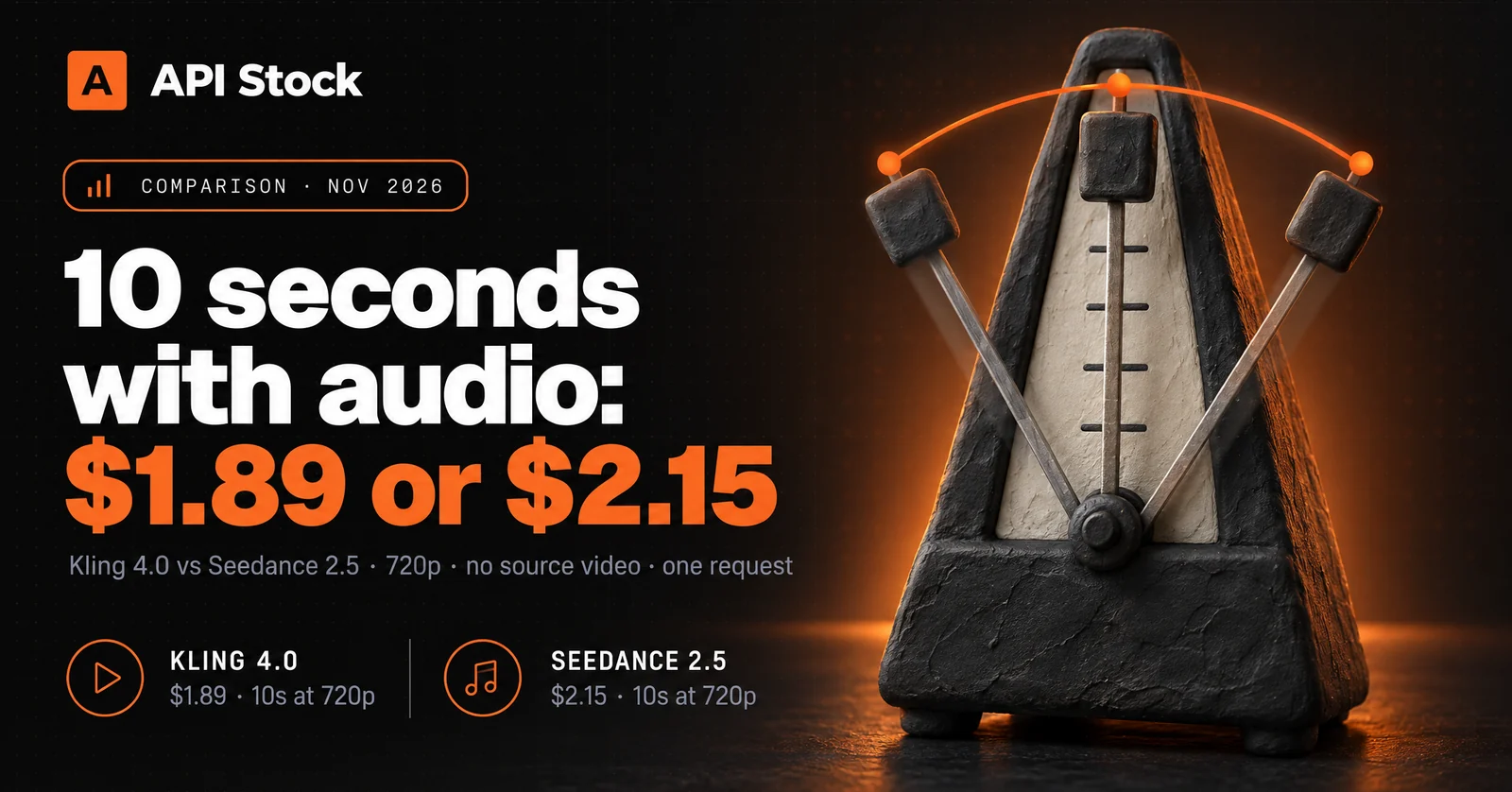
A ten-second 720p request with audio and no source video costs $1.89 on Kling 4.0 and $2.15 on Seedance 2.5 through API Stock. At 1080p, the same requested duration costs $2.84 and $7.62. Compare the required reference controls and every paid candidate before deciding which model belongs in your video workflow.
What changed with these releases?
Kuaishou's Kling 4.0 announcement records an October 15, 2026 launch and describes longer generation and expanded reference control. ByteDance announced Seedance 2.5 on July 31, with longer single-pass audio-video generation and multimodal references.
These releases make a practical comparison possible, but their announcements describe the developers' products. Our tables below use what the current API Stock API exposes. We did not run a head-to-head visual-quality or speed benchmark for this article; the artwork is editorial, not footage from either model.
How much does a ten-second clip cost?
Prices checked 5 November 2026 against the live catalog, in USD per requested output second. The following comparison uses text-only prompts, audio enabled, no source video, no optional tools and one request per clip.
| Output | Kling 4.0 per second | Kling, 10 seconds | Seedance 2.5 per second | Seedance, 10 seconds |
|---|---|---|---|---|
| 720p | $0.189 | $1.89 | $0.215 | $2.15 |
| 1080p | $0.284 | $2.84 | $0.762 | $7.62 |
These are service tariffs, not direct developer prices. Kling's 720p request total is $0.26 lower for the same duration. That price gap does not show that motion, sound or reference fidelity is equivalent. At 1080p, the $4.78 request gap makes it particularly useful to check whether your brief actually needs that output tier.
Seedance also offers 480p at $0.137 per second: ten seconds calculate to $1.37. Kling's current endpoint has no 480p option. That lower-resolution request is an alternative delivery choice, not an equal-resolution comparison with Kling 720p.
Which controls are exposed through this API?
| Contract | Kling 4.0 | Seedance 2.5 |
|---|---|---|
| Model ID | kling-4.0 | seedance-2.5 |
| Requested duration | 3–30 seconds | 4–30 seconds |
| Resolution | 720p, 1080p | 480p, 720p, 1080p |
| Aspect-ratio field | aspectRatio | size |
| Audio generation | generateAudio, default on | generateAudio, default on |
| Examples of reference fields | imageUrls, startFrameUrl, keyframeUrls, videoUrl | imageUrls, imageWithRoles, videoUrls, audioUrls |
Kling exposes distinct videoMode values, including elements, start/end frames, transform and video reference. Seedance exposes reference and extension hints; its local editing mode is unavailable on this endpoint. A mode name is not a promise that every combination of files is valid. Read Kling's input reference or Seedance's reference before constructing a reference-heavy job.
Both support a requested thirty-second take here. Neither currently exposes 4K through these particular inputs. Do not copy a developer showcase's settings into this API without checking its schema.
Why does input video need a separate calculation?
Adding a source video can change the billing tier as well as the creative brief. The output-only table above cannot be reused unchanged.
For Seedance 2.5 at 720p, the current input-video tariff is $0.129 per second applied to billed input-video duration plus requested output duration. A ten-second source plus ten-second output calculates to $2.58, versus $2.15 without input video. The lower per-second number does not make the whole request cheaper. The service measures source durations and rounds their total up to whole seconds.
Kling also lists separate source-video tariff cells. In its transform and video-reference modes, the service uses the probed source-video duration instead of the request's duration value for billing. Get the quote for your selected mode and files rather than substituting Seedance's input-plus-output formula. Image and audio reference capabilities, input limits and extension rules belong to the chosen model's contract. The dated snapshot preserves all published tariff cells used for this article.
What is a sensible budget for several candidates?
Suppose you need one ten-second 720p clip of a mechanical metronome, and plan three candidates with audio, without source video. Three requests calculate to $5.67 on Kling or $6.45 on Seedance.
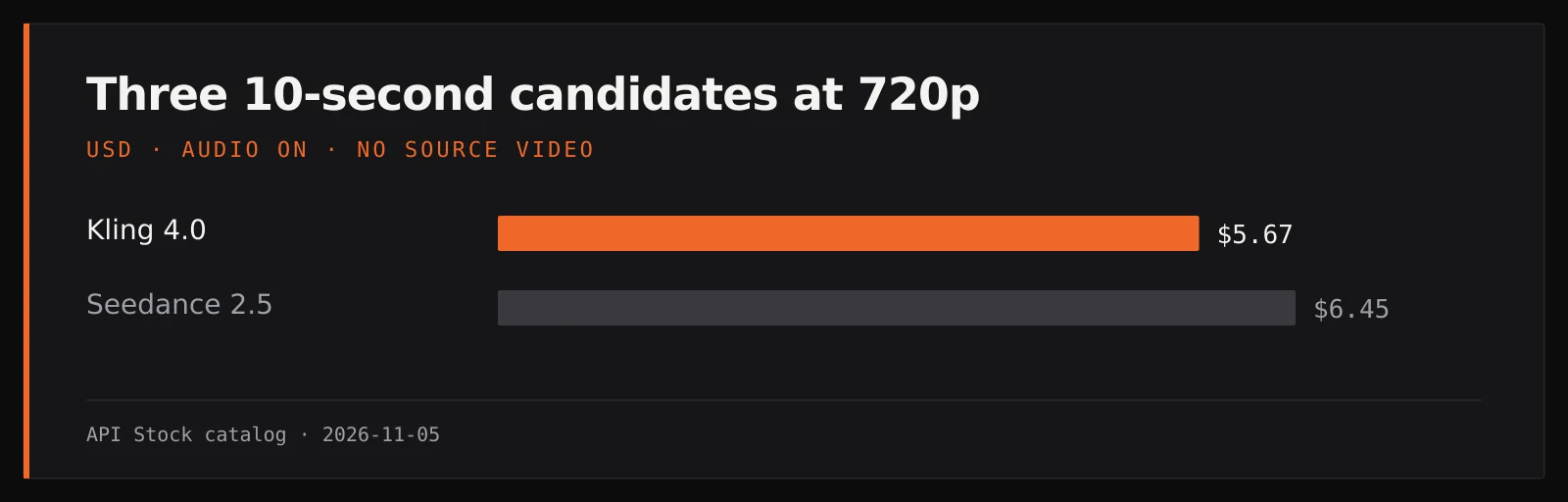
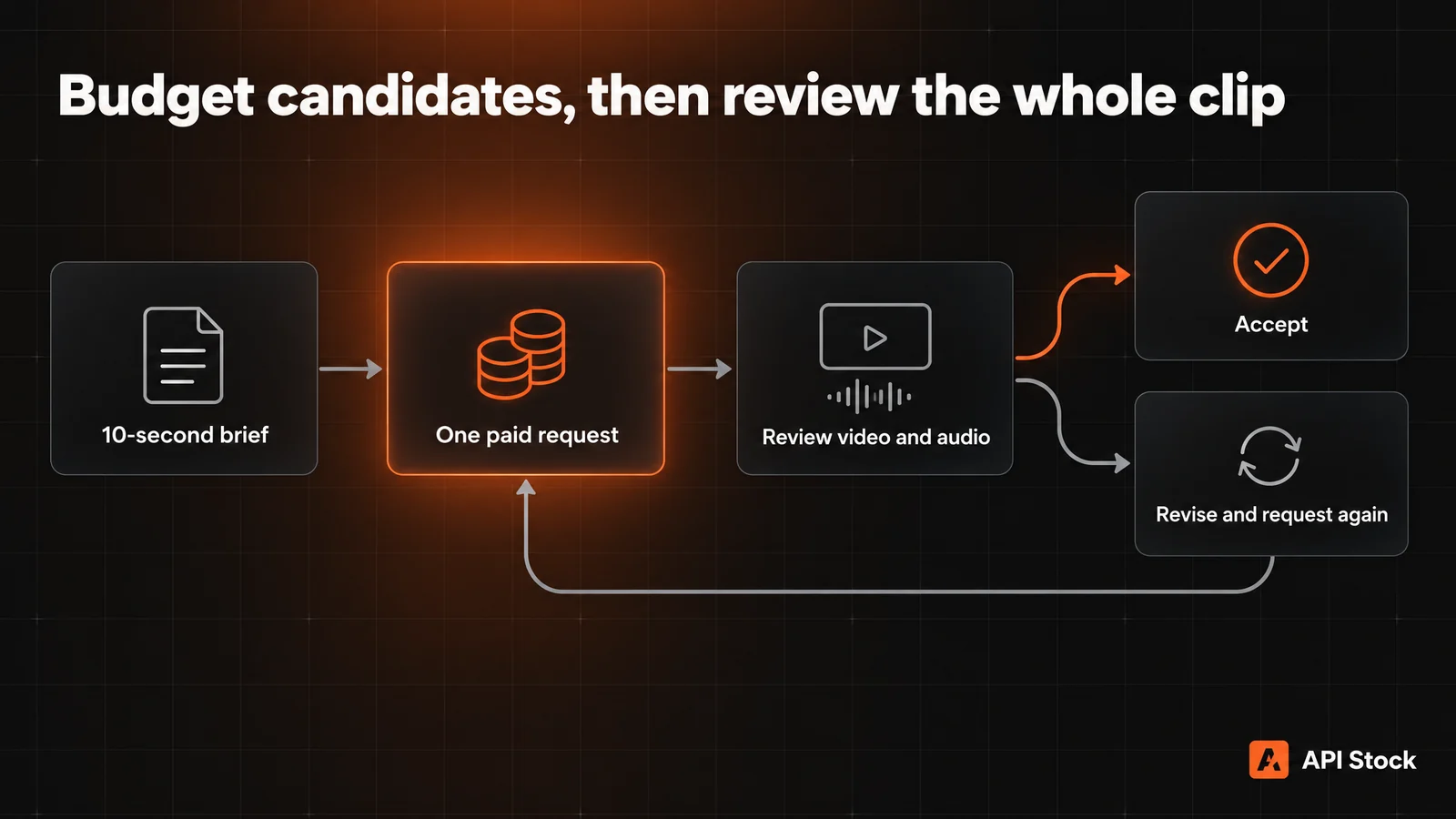
Accept a clip only if the metronome stays recognizable, the pendulum moves coherently, the shot remains continuous and the sound is usable for the edit. Watch the entire downloaded clip with audio. Three planned candidates are not a measured success rate: if only one passes, the whole three-request spend belongs to that accepted clip. A completed generation can still fail creative review.
If the same motion defect returns, simplify the movement or change the reference before buying another candidate. Final editing, music rights, captions and mixing are separate from this generation budget.
How can you request the same first shot?
These examples were checked against the public input schema and were not executed as model tests. Both request ten output seconds at 720p with audio; use your own funded API key.
curl -X POST https://api.api-stock.com/api/v1/generation/create \-H "Authorization: Bearer $API_KEY" \-H "Content-Type: application/json" \-d '{"model":"kling-4.0","input":{"prompt":"A mechanical metronome on a dark wooden desk, pendulum moving gently, locked camera, one continuous shot, soft regular ticking, no speech, no text.","duration":10,"resolution":"720p","aspectRatio":"16:9","generateAudio":true}}'curl -X POST https://api.api-stock.com/api/v1/generation/create \-H "Authorization: Bearer $API_KEY" \-H "Content-Type: application/json" \-d '{"model":"seedance-2.5","input":{"prompt":"A mechanical metronome on a dark wooden desk, pendulum moving gently, locked camera, one continuous shot, soft regular ticking, no speech, no text.","duration":10,"resolution":"720p","size":"16:9","generateAudio":true}}'
Save each returned taskId, poll GET https://api.api-stock.com/api/v1/task/status/<taskId> and wait for finished. Download data.files[].fileUrl and inspect the file. The task guide covers statuses and webhook delivery; a successful create response only confirms that the task was accepted.
For this output-only 720p brief, Kling 4.0 has the lower first-request price. Try Seedance 2.5 when its reference controls fit your actual brief, and judge the resulting clips before scaling up. Check current pricing for the exact output and input combination.
FAQ
Which model is cheaper for a ten-second clip?
Without source video, Kling is cheaper at the matched 720p and 1080p tiers in this snapshot. Seedance offers a separate 480p option that is not an equal-resolution comparison.
Does the comparison include audio?
The output-only calculations enable generateAudio on both models. Their current catalog cells do not add a separate audio surcharge for those requests.
Can I request 4K?
These current inputs expose up to 1080p. A developer announcement or another model's 4K option does not add a 4K tier to these endpoints.
Is the request price the cost of the final clip?
It is the cost of one requested generation. Add every paid candidate, then divide total spend by the number of clips you accept; editing costs are separate.
- video
- pricing
- audio
Try it with your own key
Choose a model in the API Stock catalog, check its price and try it in your browser or through the API.
Read next
 ComparisonVideo generation API pricing: what a usable clip costsCompare video API prices for matched duration and resolution. Watch actual Grok and Kling outputs, check audio differences and budget for usable clips.·10 min read
 ComparisonGPT-6.1 Sol vs Claude Opus 5.5: benchmarks and costCompare GPT-6.1 Sol and Claude Opus 5.5 using published coding benchmarks, Agent Arena results, current API tariffs and a fixed token budget.·5 min read
 ComparisonGPT-6.1 Sol vs Claude Sonnet 5.5: benchmarks and costCompare GPT-6.1 Sol and Claude Sonnet 5.5 using Artificial Analysis benchmarks, Agent Arena intervals, API protocols and a fixed token budget.·6 min read