Comparison
GPT-6.2 Sol vs Astra for coding: benchmarks and API cost
Start with Sol for testable code fixes. Compare both GPT-6.2 models in the same Codex harness and calculate the API cost of a patch that passes your tests.
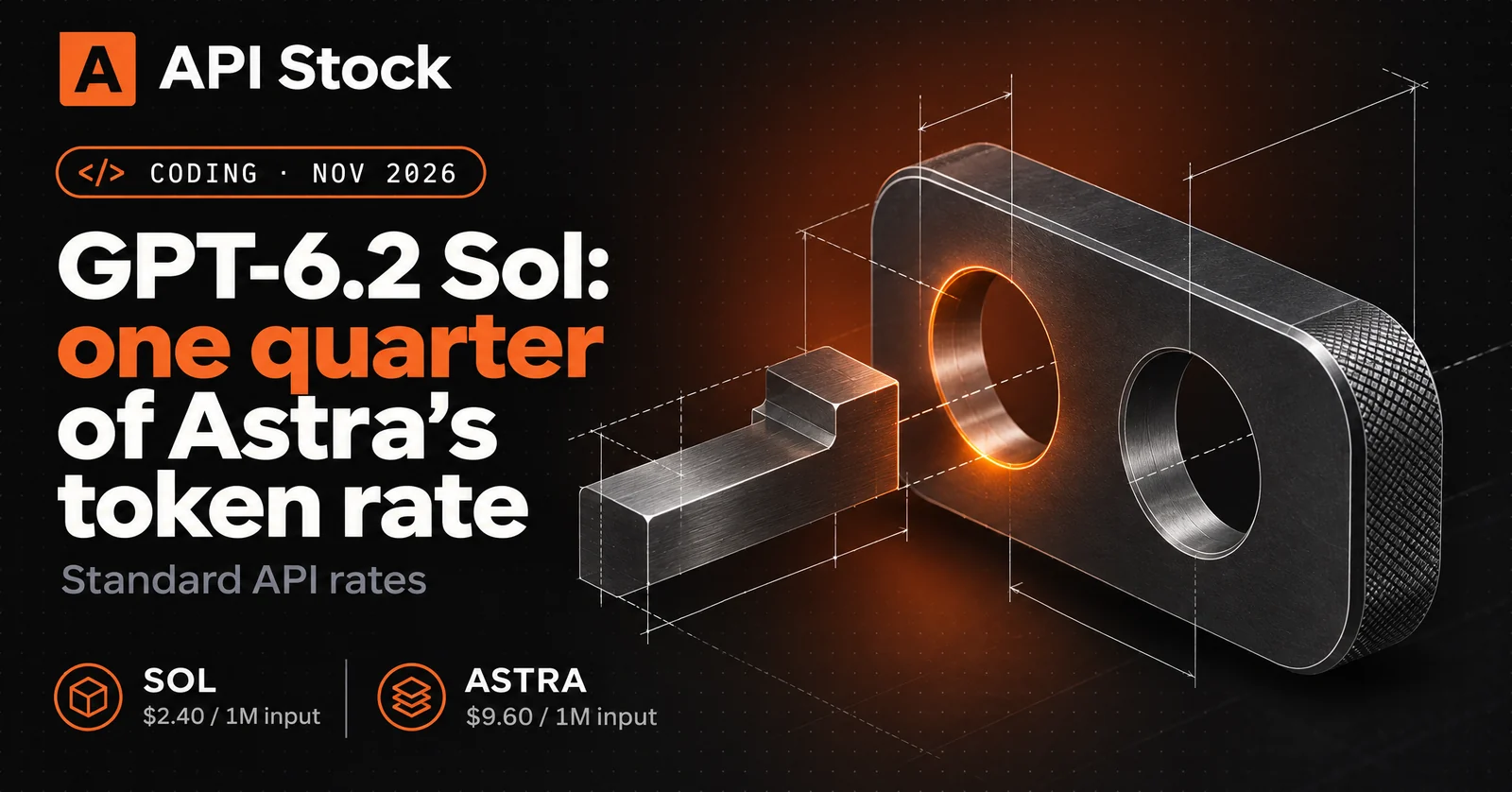
Start with GPT-6.2 Sol for a small fix you can verify with a regression test. On API Stock, a request with 10,000 uncached input tokens and 1,000 billed output tokens costs an estimated $0.036 on Sol or $0.144 on Astra. Try Astra when Sol's patch misses a requirement or the fix spans several modules that share the same behavior.
What does the same Codex harness show?
Artificial Analysis published these results for both GPT-6.2 models in Codex at Medium effort. Its FrontierCode-AA 2.0 rubric gives a patch zero if a blocking check fails. It covers 132 changes to open-source repositories, with three attempts per task. Results, retrieved 20 November 2026 · Method.
| Codex with Medium effort | GPT-6.2 Sol | GPT-6.2 Astra |
|---|---|---|
| FrontierCode-AA 2.0 · mean rubric score | 36% | 40% |
| SWE-Atlas-QnA-AA · pass@1 | 50% | 54% |
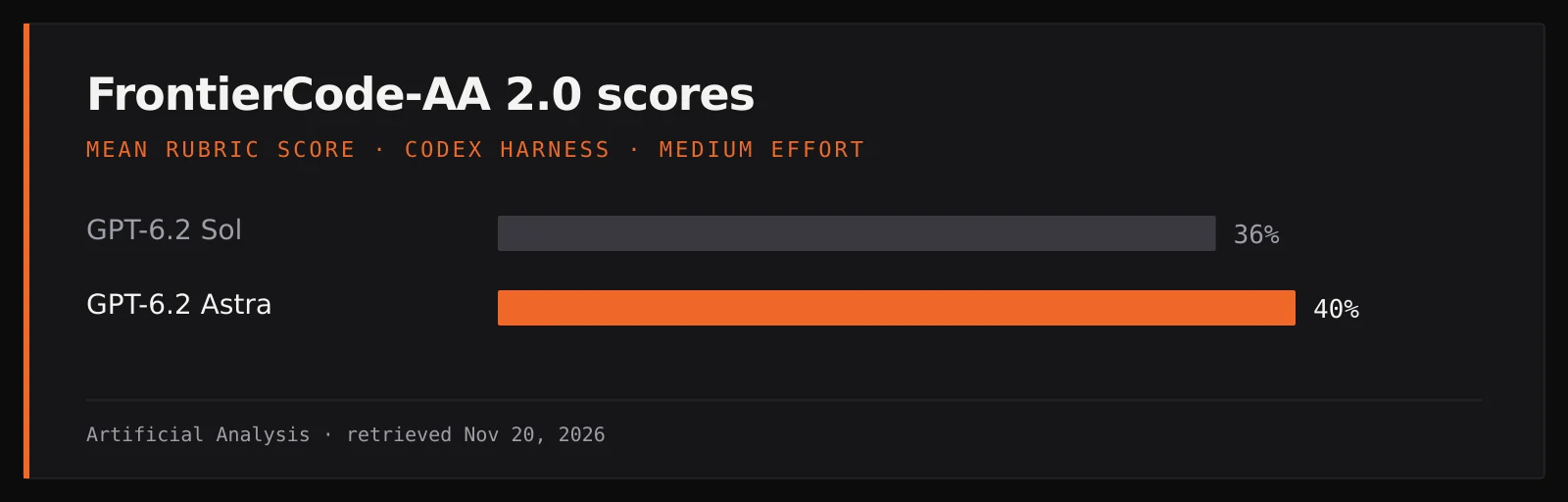
SWE-Atlas-QnA-AA measures whether the agent can trace code and explain its behavior across 124 repository questions. The two rows use different scoring rules. A FrontierCode score of 40% includes partial rubric credit for patches that pass all blocking checks. It cannot be read as the percentage of patches a maintainer accepted.
If you already use Codex, Artificial Analysis also reports a 40% FrontierCode score for Sol at Xhigh. That ties Astra at Medium at the table's displayed precision. It gives you another configuration to test before switching models. Reasoning effort can change token use, and the benchmark table supplies neither per-row confidence intervals nor exact run dates. These are independent benchmark results from a tool-using harness. Your chat request has a different setup. Dated benchmark data.
What does an accepted patch cost?
The catalog lists these API Stock rates per million tokens in USD, checked on 20 November 2026.
| Standard tariff | GPT-6.2 Sol | GPT-6.2 Astra |
|---|---|---|
| Uncached input | $2.40 | $9.60 |
| Output | $12.00 | $48.00 |
| Cache read | $0.12 | $0.48 |
| Cache write | $3.00 | $12.00 |
Ten thousand uncached input tokens and one thousand billed output tokens cost 0.01 × 2.40 + 0.001 × 12 = $0.036 with Sol. The same workload costs 0.01 × 9.60 + 0.001 × 48 = $0.144 with Astra. At that fixed size, four paid Sol attempts cost the same as one Astra attempt. Measure actual usage and divide the total spend on all attempts by the number of patches you accept.
Once total input exceeds 272,000 tokens, the long-context rates apply to the whole request. Input and output rise to $4.80 and $18.00 per million for Sol, or $19.20 and $72.00 for Astra. Cache read and write rates also change. Check current pricing and the catalog before pricing a large repository prompt.
How can you try both models on the same fix?
Suppose a CSV report adds a duplicate header on its second write. Prepare a failing fixture that writes two rows in separate calls, then supply the smallest relevant function and its tests. Request a minimal change and check that the first write still creates a header, the second adds only its row, and quoted commas survive both writes.
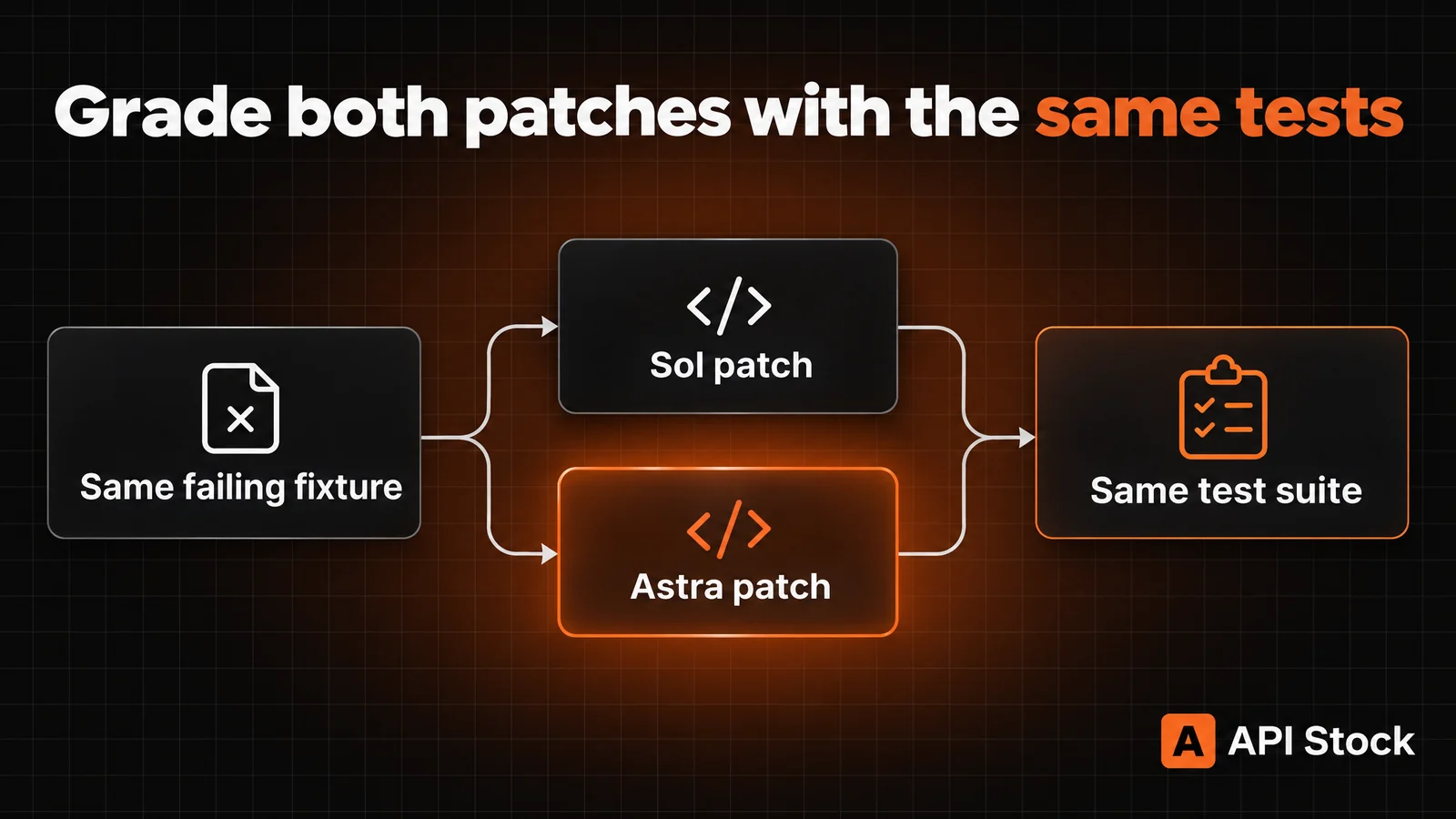
Use GPT-6.2 Sol first. If it misses a test, try GPT-6.2 Astra with the same context. The Chat Completions guide lists both IDs. The request below was checked against the documented contract and can suggest a patch for the inline JavaScript example.
MODEL=gpt-6.2-solcurl -fsS https://api.api-stock.com/api/v1/chat/completions \-H "Authorization: Bearer $API_KEY" \-H "Content-Type: application/json" \-d "$(jq -n --arg model "$MODEL" '{model: $model,messages: [{role: "user",content: "This JavaScript helper appends an already encoded CSV row. Make the smallest patch so the header appears exactly once across repeated calls, and show a regression test. Keep row encoding unchanged. Function: function appendRow(csv, row) { return csv + \"name,score\\n\" + row + \"\\n\"; }"}],max_completion_tokens: 2048}')"
Read the proposed change in choices[0].message.content and record the response usage. Apply each candidate to the same starting revision and run the same checks. Chat Completions returns the suggestion. You run the test suite in your checkout.
FAQ
Should I retry Sol or switch to Astra?
Give Sol one retry if your first prompt omitted a test case or a relevant helper. If the brief is complete and the patch still violates a requirement, compare Astra on the same fixture.
Do both GPT-6.2 models support function tools on this endpoint?
Both accept text and images via API Stock Chat Completions. For a workflow that calls tools through this endpoint, choose a model whose catalog entry lists tool support.
Does Medium mean the same number of tokens on both models?
Medium is the effort label used in the published benchmark. Token consumption can differ by model and task, so compare actual billed usage.
Is $0.036 a fixed charge for Sol?
It is the calculation for the stated token workload with standard rates and no cache. Actual charges follow usage, cache categories and the applicable context tier.
- llm
- coding
- benchmarks
- pricing
Try it with your own key
Choose a model in the API Stock catalog, check its price and try it in your browser or through the API.
Read next
 ComparisonGPT-6.1 Sol vs Claude Opus 5.5: benchmarks and costCompare GPT-6.1 Sol and Claude Opus 5.5 using published coding benchmarks, Agent Arena results, current API tariffs and a fixed token budget.·5 min read
 ComparisonGPT-6.1 Sol vs Claude Sonnet 5.5: benchmarks and costCompare GPT-6.1 Sol and Claude Sonnet 5.5 using Artificial Analysis benchmarks, Agent Arena intervals, API protocols and a fixed token budget.·6 min read
 ComparisonGPT-6 Astra vs Claude Fable 5.1: benchmarks and costCompare GPT-6 Astra and Claude Fable 5.1 with published benchmarks, Agent Arena confidence intervals, API prices and two explicit cache scenarios.·5 min read