Comparison
Video generation API pricing: what a usable clip costs
Compare video API prices by supported duration, resolution and audio. See a 10-second cost table, a worked production budget and a runnable request.
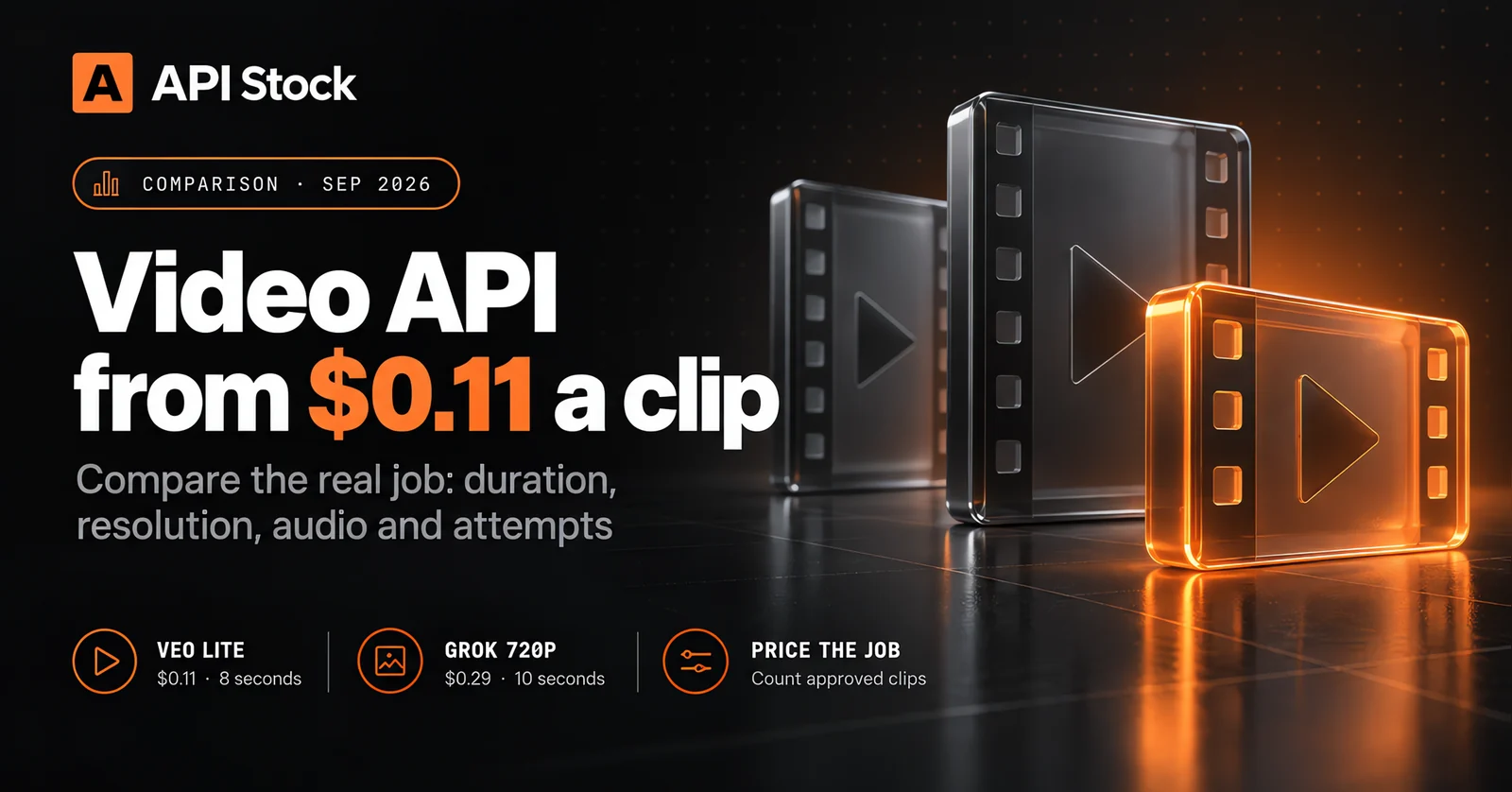
An 8-second Veo 3.1 Lite clip costs $0.11 through API Stock; a 10-second, 720p Grok Imagine 1.5 clip costs $0.29. Those figures answer different questions. To compare video generation APIs fairly, match the length you can actually request, the resolution, whether audio is included, and how many attempts it takes to get a usable shot. Prices below are from the live catalog on 28 September 2026.
How do video generation APIs calculate the bill?
The catalog has three common billing shapes. Per-clip models charge a fixed amount for one supported clip: Veo 3.1 Lite is $0.11 for eight seconds at 720p or 1080p. Per-second models multiply their tier rate by the requested output duration: Grok Imagine 1.5 at 720p is $0.029 × 10 = $0.29 for ten seconds. Duration matrices list separate prices for specific combinations: Seedance 1.5 Pro charges $0.24 for an eight-second 720p clip without audio, but $0.48 with audio.
The bill for a finished asset is usually larger than the price of one generation. If you approve one in four outputs, a $0.29 request costs roughly $1.16 per approved clip, before editing. That is a planning assumption, not a measured model success rate. Test your own prompts and count accepted outputs before choosing a production tier.
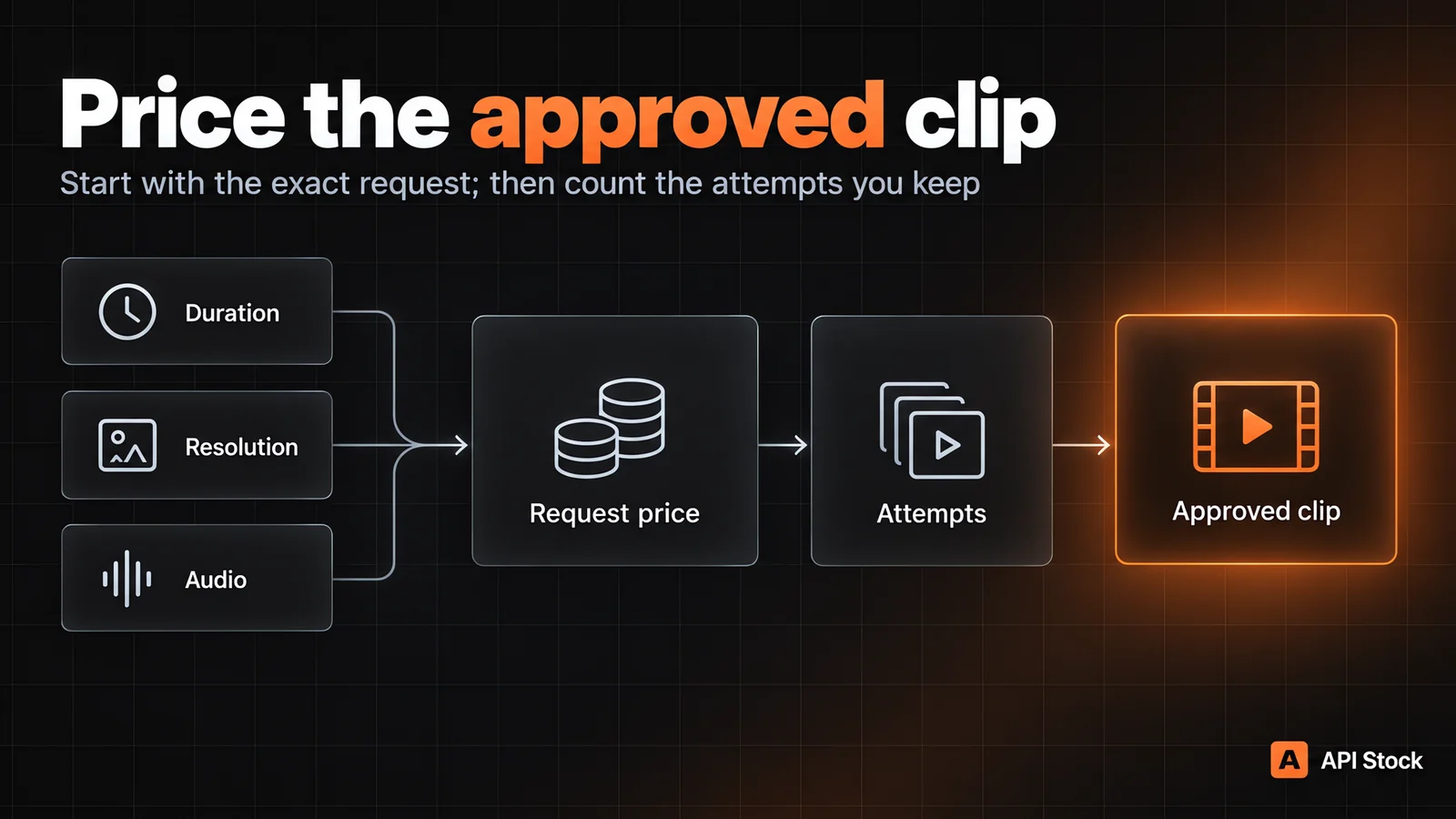
Which 720p API costs least for a 10-second video?
For an exact 10-second, 720p text-to-video request, the following models have a compatible duration. These are request prices, with no estimate for retries or editing. A lower price says nothing by itself about the quality of the output.
| Model and 720p tier | Catalog rate | 10-second request | Important condition |
|---|---|---|---|
| Grok Imagine 1.5 Video | $0.029/s | $0.29 | Supports 6, 10, 15, 20, 25 or 30 s |
| Seedance 2.0 Mini | $0.03432/s | $0.34 | Text-to-video; 4–15 s |
| Kling 3.0 | $0.09/s | $0.90 | Without generated audio |
| Seedance 2.0 Fast | $0.1284/s | $1.28 | Text-to-video tier |
| Kling 3.0 | $0.135/s | $1.35 | With generated audio |
| Seedance 2.5 | $0.324/s | $3.24 | Text-to-video tier |
Prices as of 28 September 2026, USD through API Stock. Totals are the catalog rate multiplied by ten and rounded to cents for display; actual charging follows the selected tier. Seedance's -input rates apply to a different input workflow and are deliberately excluded from this text-to-video table. The compare tool shows model features alongside prices.
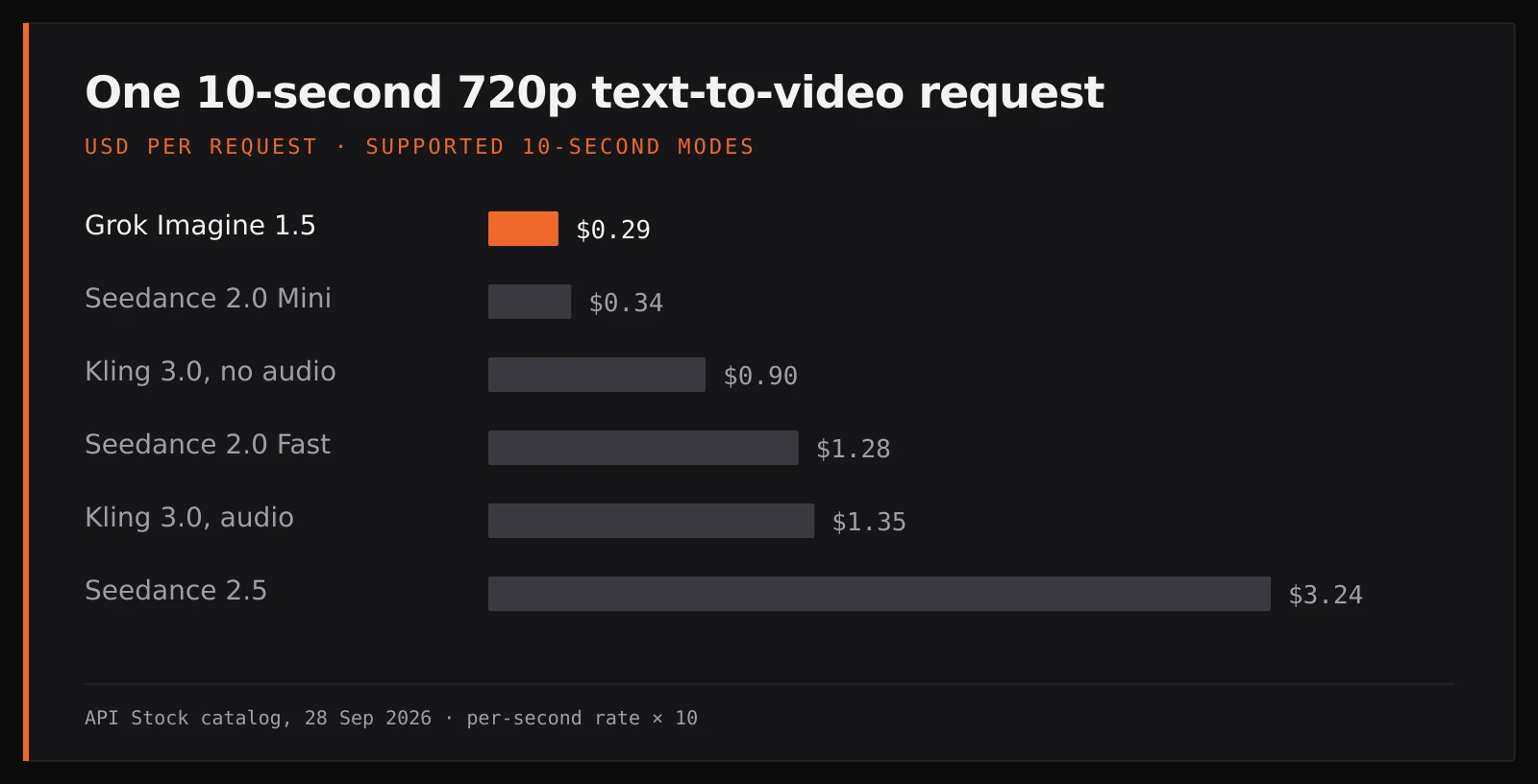
Grok wins this particular price test. If you need a first frame or mixed media references, compare the relevant image-to-video tiers separately. If the scene needs sound, compare audio-enabled variants: Kling's 720p rate rises from $0.09 to $0.135 per second. The text-to-video guide helps with prompts; the image-to-video guide covers reference frames.
Why is an eight-second Veo clip missing from the 10-second table?
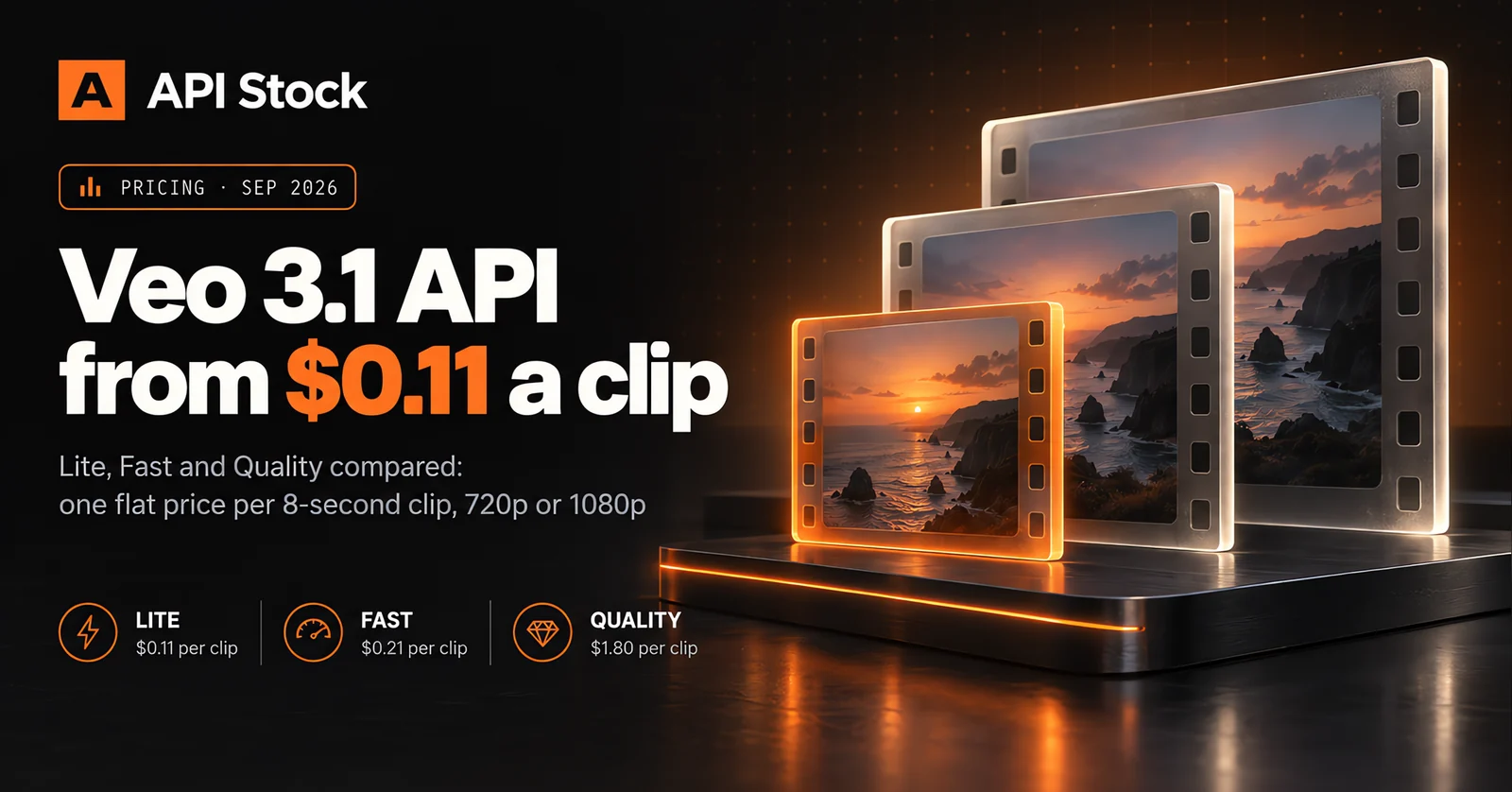
Veo 3.1 returns an eight-second clip, so it cannot fill an exact ten-second take in one request. Its 720p and 1080p prices are still useful when eight seconds fits the edit: Lite is $0.11, Fast is $0.21, and Quality is $1.80. Lite takes text only; use Fast or Quality when the input must include frames or reference images. All three return a clip with sound.
Dividing Lite's $0.11 by eight gives an effective $0.01375 per delivered second, but it is not a per-second tariff: asking for a four-second Veo clip does not halve the price. Conversely, a 10-second request on Grok costs $0.29, not the $0.232 you get by multiplying its rate by eight. The Veo tier breakdown covers the fixed-clip options in detail.
What changes when the job needs audio, references or 1080p?
Start with the output specification, then choose a model. For a silent social clip, Grok at 720p or Seedance Mini can be economical. For a clip with generated audio, check whether the selected mode produces it and whether the audio switch changes the price. For a product shot tied to an approved still, use a model that accepts an image; a cheap text-only request that cannot preserve the product is wasted spend.
Resolution is another frequent trap. Grok's 480p rate is $0.016/s and its 720p rate is $0.029/s; 1080p is not listed for this model. Kling 3.0 without audio rises from $0.09/s at 720p to $0.12/s at 1080p. Veo Lite lists the same $0.11 clip price for 720p and 1080p. Check the exact tier on the pricing page immediately before a large batch: a model's lowest advertised rate is rarely the rate for every output format.
The provider may also reject a request that asks for an unsupported duration or combination. Grok accepts discrete durations starting at six seconds; Seedance Mini permits four through fifteen seconds. Request the nearest supported duration that serves your edit, then price that duration. Do not silently normalize every model to an eight-second clip.
What would 100 approved clips cost?
Suppose a campaign needs 100 approved ten-second, 720p clips and, in your pilot, one in four generated clips is accepted. You would budget for 400 requests. At the catalog rates above, Grok would cost about $116, Seedance Mini $137.28, and Kling without audio $360. These are arithmetic scenarios, not promised outcomes: approval rates vary by prompt, subject and your quality bar.
There is a useful break-even test. If a $0.90 Kling attempt is approved four times as often as a $0.29 Grok attempt, it can be cheaper per approved clip despite the higher request price. Track approved / generated for each model in your own workflow, then divide total spend by approved clips. Include human review and post-production time if those are material. A saving of a few cents per request is irrelevant if it creates hours of manual repair.
How do you send a first video API request?
This request asks for a supported ten-second 720p Grok clip. Replace the key and prompt, then poll the returned taskId.
curl -X POST https://api.api-stock.com/api/v1/generation/create \-H "Authorization: Bearer $API_STOCK_KEY" \-H "Content-Type: application/json" \-d '{"model": "grok-imagine-1.5-video","input": {"prompt": "A slow tracking shot past a ceramic cup in morning window light","duration": 10,"resolution": "720p","size": "16:9"}}'
The API returns a task immediately. Poll GET /api/v1/task/status/{taskId} or supply a webhook URL when creating it; a finished task includes the file URL. The task and webhook documentation explains statuses, retries and refund behavior. For a production integration, keep the model, resolution and duration in configuration so you can change tiers without rewriting the job pipeline.
FAQ
What is the cheapest video generation API per second?
There is no single answer without a workflow and resolution. In the 720p ten-second text-to-video example above, Grok Imagine 1.5 costs $0.29 and Seedance 2.0 Mini costs about $0.34 as of 28 September 2026. Veo Lite costs less per request at $0.11 but returns an eight-second clip.
Is Veo 3.1 priced per second?
No. The listed 720p and 1080p prices are per eight-second generation: $0.11 Lite, $0.21 Fast and $1.80 Quality. A per-second number derived from those prices is useful for analysis, not for billing.
Does adding audio raise the video API price?
It depends on the model and tier. Kling 3.0 at 720p rises from $0.09/s without audio to $0.135/s with it. Veo's listed clip price already covers its generated-sound output.
How should I estimate a monthly video API budget?
Multiply the price of your exact duration, resolution and audio tier by expected requests, then adjust using the measured number of attempts per approved clip. Add a margin for experiments and check the current catalog before committing to a budget.
- video
- pricing
- comparison
- api
Try it with your own key
Every model mentioned here is live in the API Stock catalog — one API key, one prepaid balance, automatic fallback between providers.
Read next
 TutorialSuno API guide: all 31 actions, modes and pricesA practical map of all 31 Suno API actions: create songs, edit tracks, extract stems and data, choose simple or custom mode, and price each step.·7 min read
 PricingVeo 3.1 API pricing: Lite vs Fast vs Quality, per clipWhat one Veo 3.1 clip costs through the API on each tier, how that compares with Sora 2, Kling 3.0 and Seedance per second, and when Lite is enough.·5 min read