Comparison
Nano Banana 2.1 vs GPT Image 2.5: prices and image size
Choose between Nano Banana 2.1 and GPT Image 2.5 Sunburst using current 1K, 2K and 4K prices, editing limits and a budget for image candidates.
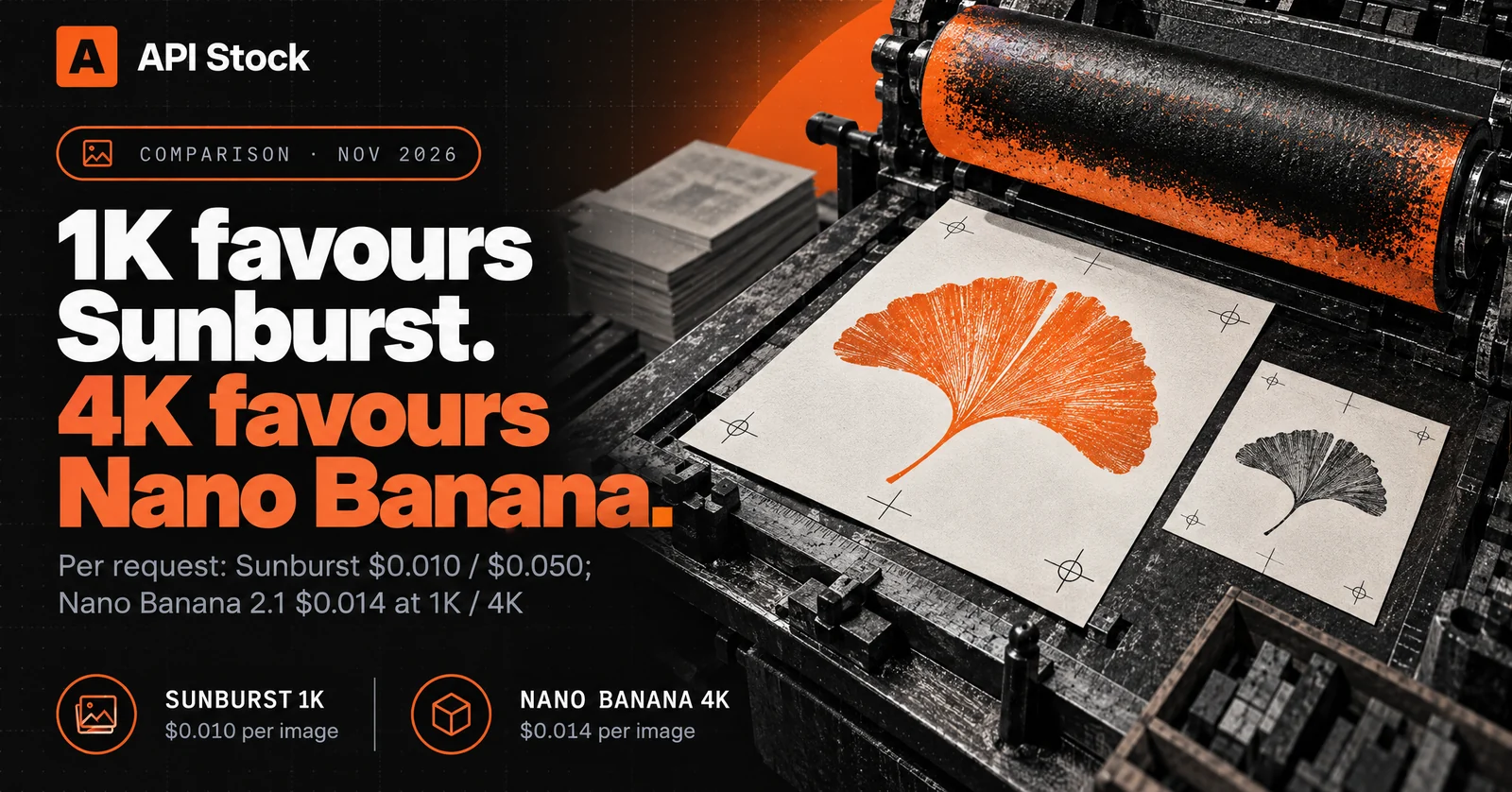
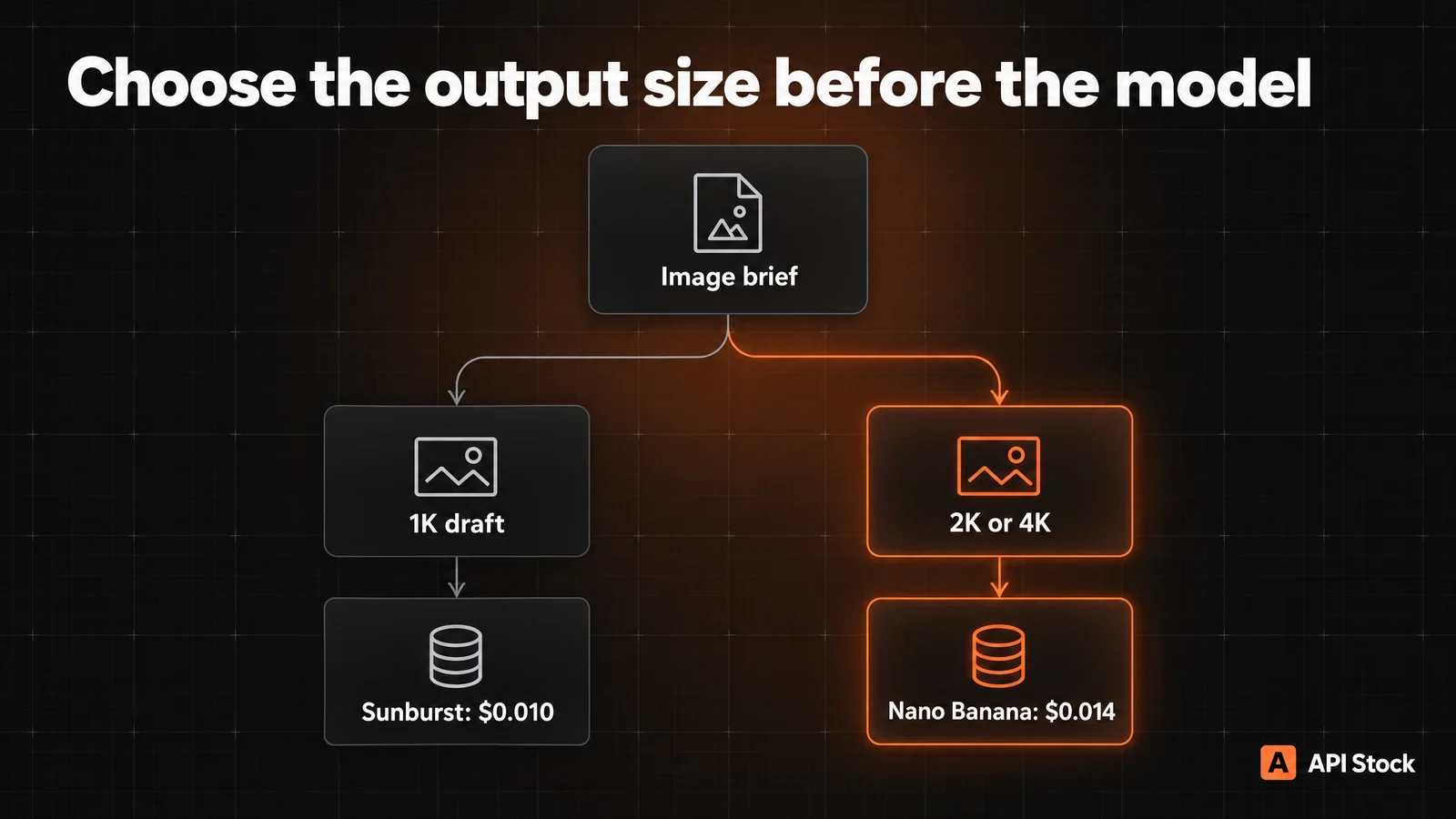
GPT Image 2.5 Sunburst has the lower 1K request price: $0.010 against Nano Banana 2.1's $0.014. At 2K and 4K, Nano Banana keeps its $0.014 tariff while Sunburst rises to $0.035 and $0.050. Choose the delivery size first, then compare the number of attempts needed for an acceptable image.
What makes this comparison useful now?
Google's small-business tools announcement discusses Nano Banana 2.1 in campaign creation. OpenAI's Sunburst documentation describes generation and editing from text and image inputs. These are developer descriptions, not evidence that either model will preserve your product or set every letter correctly.
Both catalog entries on API Stock support text-to-image and reference-based editing. This comparison covers their exposed parameters and current tariffs, without claiming a measured quality winner. For the standalone Nano Banana overview, use the existing 2.1 review; the question here is which of these two entries fits a particular delivery size and budget.
How do 1K, 2K and 4K prices compare?
Prices as of 5 November 2026, USD per single-image request from the live catalog. These are API Stock tariffs, not the developers' native token-based image bills.
| Resolution | Nano Banana 2.1 | GPT Image 2.5 Sunburst | Lower request price |
|---|---|---|---|
| 1K | $0.014 | $0.010 | Sunburst |
| 2K | $0.014 | $0.035 | Nano Banana |
| 4K | $0.014 | $0.050 | Nano Banana |
For 100 requests, that means $1.40 for Nano Banana at any listed resolution. Sunburst calculates to $1.00 at 1K, $3.50 at 2K or $5.00 at 4K. At 4K the Nano Banana request tariff is 72% lower, assuming the same number of requests. This does not establish equal quality or the same number of accepted images.
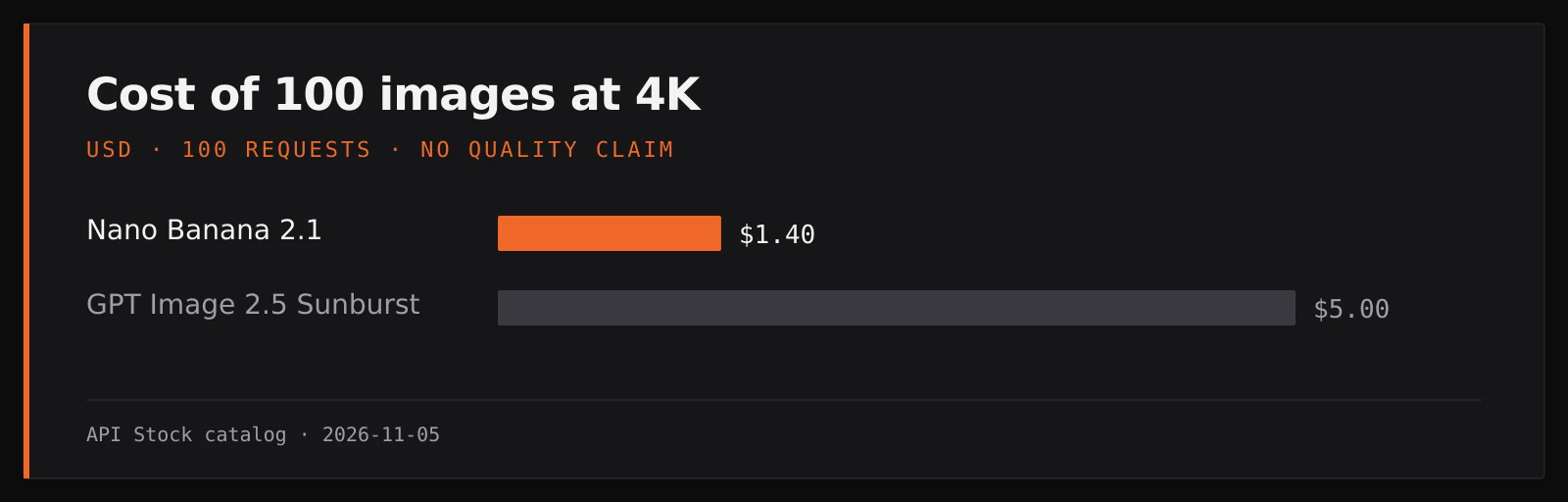
For a small draft, Sunburst is the cheaper first request. For a final 2K or 4K illustration, Nano Banana is the lower-cost candidate to evaluate first. More pixels do not fix incorrect anatomy, unreadable packaging or a poor crop. Inspect the downloaded dimensions and the actual content before delivery.
What can you generate or edit through this API?
| Public contract | Nano Banana 2.1 | Sunburst |
|---|---|---|
| Exact model ID | nano-banana-2.1 | gpt-image-2.5-sunburst |
| Image reference field | urls | urls |
| Resolution values | 1K, 2K, 4K | 1k, 2k, 4k |
| Aspect-ratio field | size | size |
| One request | One generated image | One generated image |
Use the exact case in the resolution values. Both offer standard square, portrait and landscape ratios; their longer-ratio options differ. Sunburst's 1:3 and 3:1 require 2K or 4K. An application should read the relevant model schema rather than copy every parameter from the other model.
The reference field enables an editing brief, but these public inputs do not expose a pixel mask. An uploaded photo does not guarantee unchanged product geometry, logos or readable labels. Keep an original product cutout as a separate layer when its pixels must remain exact, and verify the image API reference before building an editing UI.
How should you budget image candidates?
Suppose a landing page needs ten 4K botanical illustrations, and you plan three candidates per illustration. That is 30 separate requests: $0.42 on Nano Banana or $1.50 on Sunburst at this snapshot's tariffs.
Three candidates is a planning assumption. If those requests produce ten accepted images, spend per accepted image is $0.042 or $0.15. If only five pass review, the same spend divides by five. Record your actual accepted count; a successfully completed API task is not automatically an approved asset.
Use a concrete acceptance rule: the requested plant is identifiable, leaf shapes are coherent, the composition leaves room for text, and the crop fits the page. Evaluate the same brief at the same aspect ratio and resolution. If both fail the same detail, simplify the illustration or supply a reference before ordering more candidates.
What should the first request look like?
This schema-checked example requests one 4K Nano Banana image. It was not executed as a comparative test:
curl -X POST https://api.api-stock.com/api/v1/generation/create \-H "Authorization: Bearer $API_KEY" \-H "Content-Type: application/json" \-d '{"model":"nano-banana-2.1","input":{"prompt":"Editorial botanical illustration of a ginkgo branch, three fan-shaped leaves, clean neutral background, empty left third for a headline, no text or logos.","size":"16:9","resolution":"4K"}}'
To test Sunburst under the same brief, use gpt-image-2.5-sunburst and lowercase 4k. Do not add a batch parameter: each call creates one image task. Save the returned taskId and poll:
curl "https://api.api-stock.com/api/v1/task/status/$TASK_ID" \-H "Authorization: Bearer $API_KEY"
Wait for finished and download the URL in data.files[].fileUrl; a task ID alone is not a finished file. Follow the task-status guide for failures and webhook-based delivery. The generated artwork in this article explains the decision and is not a side-by-side output test.
Start with Sunburst for the lower 1K tariff or Nano Banana 2.1 for the lower 2K/4K tariff. The dated snapshot preserves the comparison; current pricing is the place to check before a batch.
FAQ
Is Nano Banana 2.1 cheaper than Sunburst?
At 2K and 4K, its request tariff is lower in this snapshot. At 1K, Sunburst costs $0.010 versus $0.014.
Does the same resolution mean the same quality?
It establishes a comparable output-size tier, not equal detail, fidelity or acceptance rate. Compare actual outputs using the same brief.
Can both models edit a reference photo?
Both expose urls for image references. The public inputs compared here do not expose a pixel mask or guarantee exact preservation of the source.
Can I request ten images with one call?
Each media request creates one generation. Make separate tasks and include every paid candidate in the budget.
- image
- pricing
- editing
Try it with your own key
Choose a model in the API Stock catalog, check its price and try it in your browser or through the API.
Read next
 ComparisonGPT-6.1 Sol vs Claude Opus 5.5: benchmarks and costCompare GPT-6.1 Sol and Claude Opus 5.5 using published coding benchmarks, Agent Arena results, current API tariffs and a fixed token budget.·5 min read
 ComparisonGPT-6.1 Sol vs Claude Sonnet 5.5: benchmarks and costCompare GPT-6.1 Sol and Claude Sonnet 5.5 using Artificial Analysis benchmarks, Agent Arena intervals, API protocols and a fixed token budget.·6 min read
 ComparisonGPT-6 Astra vs Claude Fable 5.1: benchmarks and costCompare GPT-6 Astra and Claude Fable 5.1 with published benchmarks, Agent Arena confidence intervals, API prices and two explicit cache scenarios.·5 min read