Pricing
Seedance 2.5 API: release date, pricing and cost per clip
Seedance 2.5 costs $2.15 for ten seconds at 720p or $7.62 at 1080p; see reference-video billing and a three-shot budget with extra attempts.
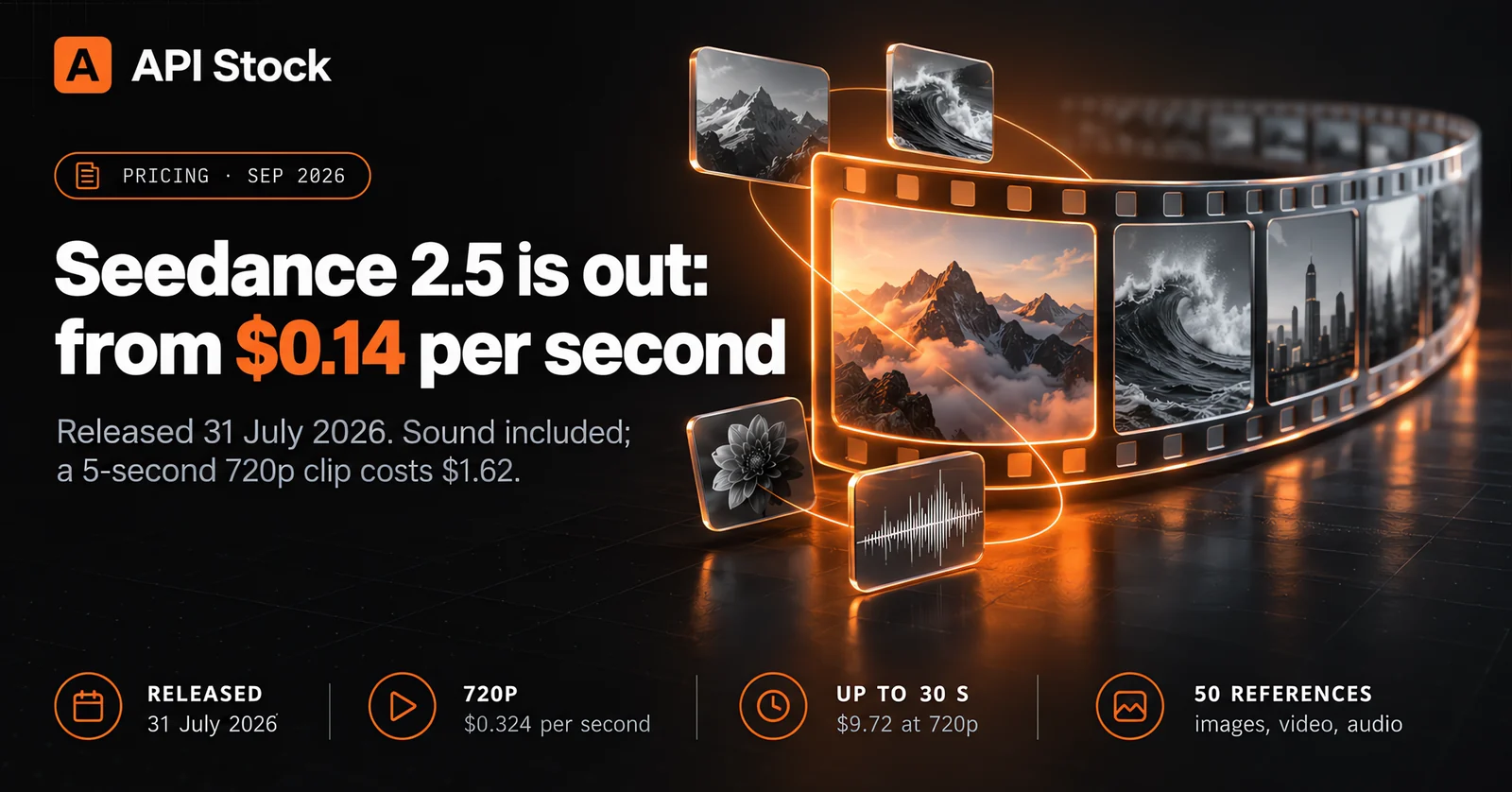
Seedance 2.5 costs $0.137/s at 480p, $0.215/s at 720p and $0.762/s at 1080p through API Stock when you supply no input video. Ten seconds cost $2.15 at 720p or $7.62 at 1080p, using the public catalog checked on 5 November 2026. With a reference video, a different rate applies to input-video seconds plus requested output seconds, so compare the whole request before choosing a rate.
Updated 5 November 2026. Mini now costs $0.036/s at 720p, down from the $0.038/s shown in the previous revision; the Seedance 2.5 tariffs are unchanged from our 26 October check. We corrected the tier comparison, replaced the old comparison chart with the current table, added Mini to the three-shot budget and calculated when reference-video duration outweighs its lower rate. The original cover and social card retain their 30 September 2026 prices. This is a tariff calculation and schema-checked recipe, not a quality or speed test.
When was Seedance 2.5 released?
ByteDance published its Seedance 2.5 announcement on 31 July 2026. The announcement describes longer single-pass generation and expanded multimodal referencing. That release date is distinct from availability or feature support on any particular API service.
On API Stock, seedance-2.5 accepts 4–30 seconds and offers 480p, 720p and 1080p. Those are the options in this service's current schema; an announced capability elsewhere does not establish that our endpoint exposes it. Local region/time-range editing is not currently available through this endpoint.
How much does a clip cost without input video?
A text-only request, a first-frame image request and an image/audio reference request all use the regular output rate. Sound is on by default; the catalog does not charge a separate audio surcharge.
Prices as of 5 November 2026, in USD per requested output second, from the live catalog. Totals below assume no input video and no optional tools.
| Output | 480p, $0.137/s | 720p, $0.215/s | 1080p, $0.762/s |
|---|---|---|---|
| 4 s, minimum | $0.548 | $0.860 | $3.048 |
| 5 s, default | $0.685 | $1.075 | $3.810 |
| 10 s | $1.37 | $2.15 | $7.62 |
| 15 s | $2.055 | $3.225 | $11.430 |
| 30 s, maximum | $4.11 | $6.45 | $22.86 |
The balance debit retains fractional cents. For example, five seconds at 720p cost $1.075; a cent-denominated display may show $1.08. Twenty such requests cost $21.50. Budget from the tariff or precise quote, not by multiplying a rounded display.
If you omit optional settings, the five-second 480p default costs $0.685. Four seconds at 480p cost $0.548 and are the minimum-duration request; the default is not the cheapest possible request.
How is a reference-video or extension request billed?
The service measures reference-video duration before charging. Its billing rule is:
request cost = (total input-video seconds + requested output seconds) × input-video tariff, with fractional cents retained in the balance debit.
Rates below are USD per second as of 5 November 2026, from the same catalog. The right-hand column applies to both input-video and output duration, not just the uploaded clip.
| Resolution | No input video: output tariff | With input video: tariff on input + output |
|---|---|---|
| 480p | $0.137/s | $0.083/s |
| 720p | $0.215/s | $0.129/s |
| 1080p | $0.762/s | $0.455/s |
At 720p, a ten-second reference video plus ten requested output seconds cost (10 + 10) × $0.129 = $2.58. Without the video, ten output seconds cost $2.15. Images and audio alone do not trigger the input-video tariff. For several videos, the service adds their measured durations and rounds the total up to whole seconds for billing, rather than using just the longest one. A 10.04-second reference counts as eleven input seconds: with ten output seconds at 720p that is 21 × $0.129 = $2.709.
At 1080p, ten input-video seconds plus ten output seconds cost 20 × $0.455 = $9.10, compared with $7.62 without input video. Choose a reference video when the brief needs its content or motion; the lower rate alone is not a reason to add one.
For a ten-second 720p output, a six-second reference costs (6 + 10) × $0.129 = $2.064. A seven-second reference costs (7 + 10) × $0.129 = $2.193, which exceeds the $2.15 output-only request. With the current tariffs and whole-second input rounding, six billed reference seconds is the longest input that keeps this particular request below the output-only price.
That boundary depends on output duration and resolution. A 6.04-second source rounds to seven billed input seconds. Keep the full motion or content your brief needs; trim a reference only if the retained segment still supplies it. A lower input-video rate does not establish a saving on the whole job.
These are billing examples, not claims that an extension preserves a scene perfectly. Inspect the output and include unsuccessful creative attempts in your budget. The model reference lists the input limits and supported modes.
How does Seedance 2.5 compare with the cheaper tiers?
For a ten-second 720p request with no input video:
Prices in USD, checked 5 November 2026 against the live catalog; audio enabled and optional tools omitted for every row.
| Model | Tariff per output second | Request total |
|---|---|---|
| Seedance 2.0 Mini | $0.036 | $0.36 |
| Seedance 2.0 Fast | $0.101 | $1.01 |
| Seedance 2.0 | $0.135 | $1.35 |
| Seedance 2.5 | $0.215 | $2.15 |
2.5 supports up to thirty images across its image fields, ten video references and ten audio references, within the duration limits in the reference. The 2.0 models accept fewer references and have a fifteen-second output limit. That makes 2.5 relevant for longer single takes or a larger reference brief; it does not prove that every short clip will look better.
For a simple ten-second shot, Mini costs $0.36 compared with 2.5's $2.15. Check whether its output meets your brief before moving to a more expensive tier. If you need 4K, Seedance 2.0 has that option; 2.5 on this endpoint does not. A new render at another resolution is a new take, not an upscale or a guaranteed match to a fixed seed.
What should you budget for a three-shot video?
Suppose you need a 30-second edit made from three ten-second shoe shots: a side view, a close-up and a wider view. Separate requests let you replace one shot without regenerating the other two. You still need an editor to assemble the clips; these totals cover generation only.
The following conditional budget uses Mini and Seedance 2.5 public USD tariffs checked on 5 November 2026. Every request has ten output seconds, audio enabled, no input video and no optional tools.
| Generation plan | Requests | Mini 720p at $0.36/request | 2.5 720p at $2.15/request | 2.5 1080p at $7.62/request |
|---|---|---|---|---|
| One candidate for each shot | 3 | $1.08 | $6.45 | $22.86 |
| Three candidates for each shot | 9 | $3.24 | $19.35 | $68.58 |
Mini can request each ten-second shot within its fifteen-second limit. Consider it for a project assembled from short shots; use 2.5 when the brief needs a single take longer than fifteen seconds or its larger reference allowance. Three separate Mini requests do not produce a continuous thirty-second take or establish consistency between cuts.
Three candidates per shot is a planning assumption, not an observed success rate. If nine paid requests yield three accepted clips, generation spend per accepted ten-second clip is $19.35 ÷ 3 = $6.45 at 720p, or $68.58 ÷ 3 = $22.86 at 1080p. If nine Mini requests yield three accepted clips, their cost is $3.24 ÷ 3 = $1.08 per accepted clip. These scenarios assume the same accepted count only to show the arithmetic; they do not predict equal quality or success rates. Use your actual spend divided by your actual accepted count when reviewing a project.
For the shoe prompt below, accept a clip only if the shoe's geometry stays stable, the camera remains fixed and the light moves as requested. Watch the whole clip and check its audio. A technically completed result that fails this review still consumes the request price. If a second attempt repeats the same defect, revise the prompt or simplify the motion before buying more candidates.
The dated pricing record links the catalog snapshot and calculation assumptions. Check the current video tariffs before a larger run. Request budgets are separate from your balance top-up amount and exclude editing costs.
How do you request and retrieve a Seedance 2.5 clip?
This text-only recipe requests a ten-second 720p task, priced at $2.15 in the 5 November snapshot. Its fields were checked against the current public schema; it was not executed as a generation test for this update. Supply your own API key and a balance sufficient for the request.
curl -X POST https://api.api-stock.com/api/v1/generation/create \-H "Authorization: Bearer $API_STOCK_KEY" \-H "Content-Type: application/json" \-d '{"model": "seedance-2.5","input": {"prompt": "A locked-off studio shot of one red running shoe on a pale grey table. A band of sunlight moves slowly across it. The shoe stays still. Sound: quiet room tone, no music.","duration": 10,"resolution": "720p","size": "16:9","generateAudio": true}}'
Read data.taskId from the create response, set TASK_ID to that value, then check status:
curl "https://api.api-stock.com/api/v1/task/status/$TASK_ID" \-H "Authorization: Bearer $API_STOCK_KEY"
Poll with increasing delays while data.status is not_started or processing. When it is finished, download the video from data.files[].fileUrl. On failed, inspect data.errorMessage; the charge is refunded. An expired task no longer has retained details. A top-level webhook on the create request can deliver completion instead; see the task docs for that contract.
For a first-frame request, supply your own accessible image using imageWithRoles and role: "first_frame", and set size to adaptive. Keeping size: "16:9" from the text-only example is incompatible with first-frame mode. This adds an image, not input-video seconds. The image-to-video guide explains the workflow.
For actual first-take Grok/Kling clips and their limitations, see the video cost comparison. Use compare to inspect two models' parameters without assuming identical behaviour.
Open the Seedance 2.5 playground, choose ten seconds at 720p and try the shoe prompt to review one $2.15 candidate before committing to a three-shot project.
FAQ
When was Seedance 2.5 released?
ByteDance's official announcement is dated 31 July 2026. Availability and exposed features depend on the service; API Stock currently lists it as seedance-2.5.
How much does ten seconds at 720p cost?
$2.15 without input video at the 5 November 2026 snapshot. Ten input-video seconds plus ten output seconds cost $2.58 under the separate input-video tariff. At 1080p, those requests cost $7.62 and $9.10 respectively.
What is the cheapest request?
Four seconds at 480p with no input video cost $0.548. The five-second 480p default is $0.685.
Does a first-frame image trigger reference-video billing?
No. Images and audio alone retain the regular output tariff. Input-video duration triggers the input-video rate on both measured input-video seconds and requested output seconds.
Can Seedance 2.5 make 4K or edit a region of a video here?
The current endpoint offers 480p, 720p and 1080p, not 4K. Reference generation and extension are supported; local region/time-range editing is not exposed here.
Is Seedance 2.5 better than Mini for short clips?
This article establishes differences in tariffs, duration and inputs, not a quality ranking. Compare results on your own brief and account for every paid attempt.
- seedance
- video
- pricing
Try it with your own key
Choose a model in the API Stock catalog, check its price and try it in your browser or through the API.
Read next
 PricingVeo 3.1 API pricing: Lite vs Fast vs Quality, per clipVeo 3.1 costs $0.10 on Lite, $0.189 on Fast and from $1.20 on Quality per eight-second clip; compare resolutions, inputs and batch budgets.·7 min read
 TutorialGemini Omni 1.2 Flash API: video edits, duration and costCreate, edit or extend video with Gemini Omni 1.2 Flash: compare 1.1 prices, calculate billable seconds, and follow one API task through to a saved file.·7 min read
 ComparisonKling 4.0 vs Seedance 2.5: audio, references and costCompare Kling 4.0 and Seedance 2.5 for ten-second videos: current 720p and 1080p costs, audio, reference inputs and a realistic candidate budget.·5 min read